Theoretical Background
This page summarizes the physical and numerical models implemented in voids.
The emphasis is on the equations, assumptions, units, and boundary conventions
that define the package's digital porous media workflows.
The main scientific boundary is simple:
voidsis a scientific Python package for digital porous media research- pore-network modeling is the main graph-based modeling approach
- map-based FVM/FEM and direct-image LBM backends provide complementary single-phase upscaling and comparison methods
- pore-network hydraulic conductance can be constant-viscosity or pressure-dependent
- conductance can be selected explicitly or through the data-adaptive
automodel - pore-network geometry can be circular, size-factor based, shape-aware throat-only, or shape-aware pore-throat-pore
- thermodynamic viscosity is available through tabulated
thermoandCoolPropbackends
If a study needs corner films, capillary entry, wettability hysteresis, or dynamic multiphase occupancy, those physics are still outside the present scope.
Pore-Network Representation
A pore network is represented as a graph
where pores are vertices \(V\) and throats are edges \(E\). For a throat \(t\) that
connects pores \(i\) and \(j\), voids stores:
- the pore coordinates \(\mathbf{x}_i\), \(\mathbf{x}_j\)
- the connectivity pair \((i, j)\)
- pore-wise and throat-wise geometric arrays
- boundary labels used to define the macroscopic experiment
- sample-scale geometry needed for Darcy-scale reporting
This matters scientifically because topology, conduit geometry, and sample geometry play different roles:
- topology controls connectivity and admissible flow paths
- local geometry controls conductance
- sample geometry controls the conversion from total flow rate to apparent permeability
voids therefore keeps those records explicit in Network, SampleGeometry, and
Provenance instead of collapsing them into one opaque container.
Single-Phase Hydraulic Conductance
Throat Flux Law
The local constitutive law used throughout voids is
where \(q_t\) is the volumetric flow rate through throat \(t\), \(g_t\) is the hydraulic conductance assigned to that throat or conduit, and \(p_i - p_j\) is the pressure drop between its end pores.
The scientific question is therefore how \(g_t\) is modeled from geometry and viscosity.
Generic Poiseuille Model
The fallback model is the circular Poiseuille conductance
where \(r_t\) and \(d_t\) are throat radius and diameter, \(L_t\) is throat length, and \(\mu\) is the dynamic viscosity.
This is exposed in voids as generic_poiseuille.
It is the correct law for creeping flow in a circular tube, but it is only an equivalent-duct approximation for image-extracted throats with irregular shape. That simplification is often acceptable for controlled baselines and regression tests, but it is not a faithful geometric closure for angular or highly non-circular ducts.
Hagen-Poiseuille Conduit Model
The Hagen-Poiseuille conduit model applies the circular segment law to a pore-throat-pore conduit when conduit sub-lengths are available:
Here \(A_s\), \(L_s\), and \(\mu_s\) are the area, length, and dynamic viscosity for each segment \(s\). For a circular segment, \(A_s=\pi r_s^2\), so this reduces to the usual \(\pi r_s^4/(8\mu_s L_s)\).
This is exposed in voids as hagen_poiseuille. If conduit lengths are absent,
the model falls back to the one-throat generic_poiseuille calculation because
that is the same segment law without pore-end resistances.
For PoreSpy-style imports, voids preserves explicit OpenPNM conduit lengths
when present. If they are absent but pore diameters, throat diameters, and a
center-to-center throat length are available, the importer derives a
sphere-cylinder pore1-core-pore2 split and records the derivation summary in
net.extra["conduit_lengths"]. This keeps the extraction path usable with
PoreSpy/PREGO region networks that expose throat.direct_length but not
throat.conduit_lengths.* directly.
Hydraulic Size-Factor Model
OpenPNM-style networks may already contain hydraulic size factors, and voids
can also generate them for PoreSpy/PREGO image-extracted networks through
transport_geometry="pyramids_and_cuboids". In that representation, the
geometry-dependent part of the conductance is reduced to size factors \(S\), and
viscosity is applied afterward:
for a throat-only size factor, or
for a three-segment pore-throat-pore conduit. This is the same algebra as combining the three segment conductances \(S/\mu\) in series.
voids preserves imported throat.hydraulic_size_factors in
net.extra["throat.hydraulic_size_factors"] and stores generated
pyramids-and-cuboids factors in net.throat["hydraulic_size_factors"] so they
round-trip through HDF5 with the rest of the network arrays. The auto
conductance model uses either location before applying any local geometry
fallback, because size factors are already a completed geometric conductance
reduction.
For the generated pyramids-and-cuboids transport geometry, pores are represented as truncated pyramids and throats as cuboids. The stored factors follow the OpenPNM convention
where \(F_s\) is the segment integral of \(1/A(x)^2\) and \(I_s=1/6\) for the square cross-section used by the pyramids-and-cuboids model. This is a transport post-processing model on top of the extracted network geometry; it is not a change to the segmentation.
Shape Factor and Equivalent Ducts
For shape-aware closures, voids uses the dimensionless shape factor
where \(A\) is cross-sectional area and \(P\) is wetted perimeter. For the circle, square, and equilateral triangle:
In the equivalent-duct construction used in this modeling family, the cross-section is represented by an admissible duct family with the same inscribed radius \(r\) and shape factor \(G\). For that family,
This relation is exact for the canonical circle, square, and triangle classes used by the Valvatne-Blunt style model.
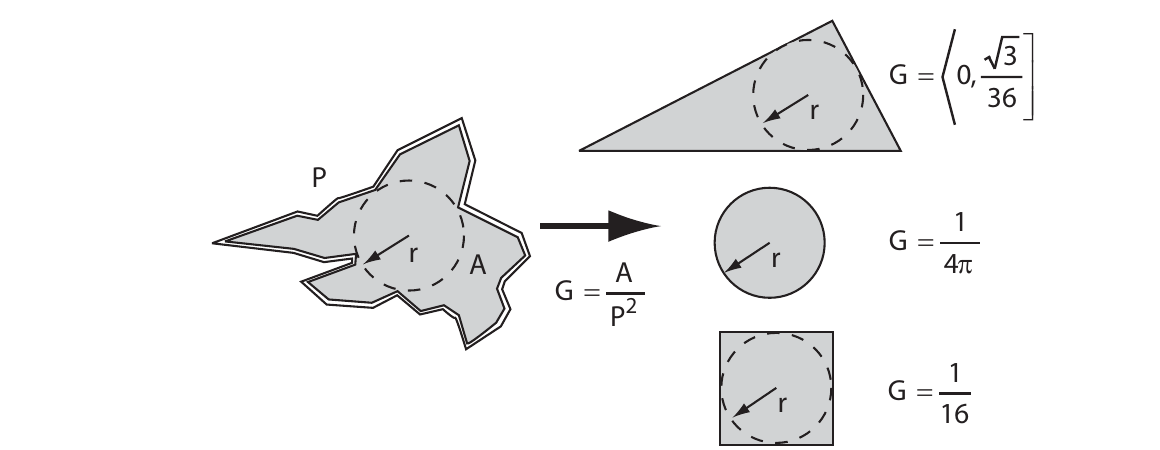
Two cautions are important:
- The pair \((r, G)\) is a reduced constitutive representation, not a full reconstruction of the original cross-section.
- The square/circle transition used in
voidsfollows a historical implementation convention. It is a pragmatic modeling rule, not a universal theorem.
Valvatne-Blunt Throat-Only Model
The throat-only shape-aware model classifies the throat from its shape factor and uses
with the single-phase coefficients
In voids this closure is exposed as valvatne_blunt_throat.
The circular limit is internally consistent. If \(G = 1/(4\pi)\), then
which recovers the usual Poiseuille conductance.
Valvatne-Blunt Conduit Model
When conduit sub-lengths are available, voids uses a pore-throat-pore series model.
Each connection is decomposed into three segments:
- pore-1 segment of length \(L_{p,1}\)
- throat-core segment of length \(L_t\)
- pore-2 segment of length \(L_{p,2}\)
For a segment \(s\), the resistance is
and the conduit resistance is
Therefore the equivalent conductance is
Equivalently, if each segment conductance is computed first,
which is the harmonic series combination implemented in voids.
This closure is exposed as valvatne_blunt. The older name
valvatne_blunt_baseline remains as a backward-compatible alias, not as a separate
physical model.
Auto Conductance Hierarchy
The default conductance model in voids is the conservative
generic_poiseuille baseline. The auto model is available when the goal is to
use the richest conductance information present in a network. Its selection logic is:
- If
throat.hydraulic_conductanceis already present, trust it directly; no viscosity is required because the constitutive reduction has already been performed. - Else, if
throat.hydraulic_size_factorsare available, use the OpenPNM-style size-factor model. - Else, if conduit lengths and explicit pore/throat shape data are available, use
valvatne_blunt. - Else, if conduit lengths and pore/throat areas are available, use
hagen_poiseuille. - Else, if explicit throat-only shape data are available, use
valvatne_blunt_throat. - Else, fall back to
generic_poiseuille.
That hierarchy is scientifically deliberate. It preserves richer geometric
information when available, while keeping the solver usable on incomplete networks.
The word "explicit" matters here: auto does not classify an area-plus-diameter
network as shape-aware unless a shape factor or perimeter was actually provided.
That avoids silently treating circular-equivalent metadata as a resolved angular
duct model.
Richer does not always mean closer to an experimental permeability target. Image
extractors may report geometric areas, shape factors, or conduit sub-lengths that
are useful descriptors but are not independently calibrated hydraulic conductance
factors. For literature-reference or regression comparisons, select the intended
model explicitly rather than relying on auto.
Precomputed throat.hydraulic_conductance is a final hydraulic conductance, not
a geometric size factor. It is therefore viscosity-inclusive and pressure
independent inside voids: pressure-dependent viscosity models will report local
viscosity fields, but they will not rescale those precomputed conductances. Use
throat.hydraulic_size_factors or a geometric model when the conductance should
remain coupled to local viscosity. For constant-viscosity permeability reporting,
the fluid viscosity passed to the solve should match the reference viscosity
implicit in the precomputed conductance.
Pressure-Dependent Viscosity
Constant-Viscosity Mode
The simplest fluid model is
with one constant dynamic viscosity applied everywhere. This remains the right choice for:
- dimensionless toy problems
- permeability comparisons where viscosity variation is negligible
- geometry-focused benchmarks where constitutive complexity would only add noise
Thermodynamic Backend Mode
voids also supports pressure-dependent water viscosity through tabulated backend
calls at fixed temperature:
Two backend families are currently supported:
thermo, through thethermo.Chemical(...).ViscosityLiquidinterfaceCoolProp, throughCoolProp.CoolProp.PropsSI
At the code level, the constitutive query is not solved directly at every pore during
every iteration. Instead, for a given boundary-pressure interval
\([P_{\min}, P_{\max}]\) and temperature \(T\), voids first tabulates the backend
response on a pressure grid:
The tabulated law is then replaced by a clipped piecewise-cubic Hermite interpolant (PCHIP):
This matters for two reasons:
- it avoids repeated expensive backend calls during the nonlinear solve
- it provides a differentiable constitutive law with an explicit derivative \(d\hat{\mu}/dP\)
Outside the tabulated interval, pressure is clipped to the interval bounds rather than extrapolated. Consequently, the effective derivative is zero outside the tabulated range.
Pore and Throat Viscosity Fields
The current solver evaluates viscosity at:
- pore centers for pore-body segments
- midpoint throat pressures for throat-core segments
For a throat connecting pores \(i\) and \(j\),
Then the local viscosities are
The same midpoint rule is used for the throat derivative:
This is not the only admissible closure, but it is consistent with the current local pressure representation used in the conduit model.
Absolute Pressure Requirement
Thermodynamic backends are queried in absolute pressure units. Therefore, unlike a constant-viscosity solve, the pair \((P_{\mathrm{in}}, P_{\mathrm{out}})\) is not only a pressure drop; its absolute level matters because the constitutive law depends on pressure itself.
In practice, this means
pin=1.0, pout=0.0is fine for dimensionless constant-viscosity tests- positive absolute pressures in Pa are required for thermodynamic viscosity solves
Nonlinear Single-Phase Solve
Governing Balance
For each free pore \(i\), steady incompressible mass conservation requires
with
If viscosity is constant, then \(g_{ij}\) is constant and the residual is linear in \(\mathbf{p}\). The usual weighted graph-Laplacian system follows:
where, for free pores,
If viscosity depends on pressure, then \(g_{ij}\) depends on \(\mathbf{p}\) through \(\mu(\mathbf{p})\), and the problem becomes nonlinear.
Picard Iteration
The Picard strategy used in voids is:
- guess a pressure field
- evaluate pore and throat viscosities from that field
- rebuild the conductance field
- solve the resulting linear pressure problem
- repeat until the pressure update is small
In symbols, with iterate \(k\),
Picard is robust and remains available as a fallback, but its convergence rate is typically linear.
Newton Linearization
The current Newton path in voids differentiates the tabulated constitutive law and
assembles the pore-balance Jacobian explicitly.
For one throat \(t = (i,j)\),
The local derivatives are
The pore-balance Jacobian is then assembled from those throat contributions. This is close to a full constitutive Newton method for the problem actually being solved, with one important caveat:
Important modeling point
The Jacobian is exact for the tabulated/interpolated constitutive law \(\hat{\mu}(P;T)\), not for the original backend callable itself. That is a deliberate approximation layer introduced for speed and numerical smoothness.
The Newton step \(\delta \mathbf{p}\) solves
followed by a damped update
with backtracking if the residual does not decrease.
Boundary Conditions and Active Domain
Dirichlet boundary conditions are imposed on labeled pore sets:
Connected components that do not touch any Dirichlet pore are excluded from the active
solve domain. This avoids singular floating-pressure blocks. Pressures and fluxes on
those excluded components are reported as nan in the returned result.
Linear Solver Options
The inner linear systems used by the constant-viscosity solve, Picard updates, and Newton steps can be solved with:
- a sparse direct solve
- conjugate gradients (
cg) - GMRES (
gmres)
voids also supports optional algebraic multigrid preconditioning through pyamg.
That is a linear algebra acceleration, not a separate physical model.
The most defensible rule of thumb is:
- use
cgpluspyamgfor constant-viscosity pressure solves when the system is close to symmetric positive definite - use
gmrespluspyamgfor Newton inner solves when pressure-dependent viscosity makes the Jacobian less symmetric
The actual speedup is geometry- and conditioning-dependent, so it should be treated as an empirical numerical option rather than as a universal guarantee.
Darcy-Scale Permeability
Map-based continuum upscaling in voids.fvm and voids.fem uses the same
Darcy reporting convention below, but the field solve is no longer a pore-network
pressure solve. The TPFA backend solves a cell-centered finite-volume Darcy problem
on a scalar permeability map. The FEM backends solve mixed Darcy-Darcy or
Darcy-Brinkman forms on porosity/permeability maps, with the local drag coefficient
\(\gamma = \mu / K\) and, for Brinkman models, an effective viscous coefficient
\(\mu / \phi\). These models are useful for direct map upscaling and
micro-continuum comparisons, but their quantitative validity still depends on the
map closure for \(K\), the porosity field, mesh resolution, pressure boundary
conditions, and representative-volume assumptions.
For the full TPFA, FEM, USFEM, and LBM formulations used by the package, see
Map-Based Single-Phase Solvers.
After solving the pore pressures, voids computes throat fluxes and sums the net
inlet flow rate \(Q\). The reported apparent permeability is then obtained from
Darcy's law:
where
- \(L\) is the sample length along the chosen axis
- \(A\) is the sample cross-sectional area normal to that axis
- \(\Delta P = P_{\mathrm{in}} - P_{\mathrm{out}}\)
- \(\mu_{\mathrm{ref}}\) is the scalar reporting viscosity
The reporting convention is:
- use
fluid.viscositydirectly if the user supplied a constant reference viscosity - otherwise, for thermodynamic viscosity, use the midpoint viscosity over the imposed pressure interval
This is a reporting choice. It does not change the solved nonlinear flow field, but it does affect the permeability value reported from that field.
Porosity and Connectivity
Absolute Porosity
Absolute porosity is
If pore.region_volume is available, voids treats it as a disjoint partition of the
void domain and uses it directly. Otherwise, it falls back to summing pore and throat
volumes. Those two bookkeeping conventions are not interchangeable and can differ
materially on extracted networks.
Effective Porosity
Effective porosity is
where the connected volume may be defined either by axis-spanning components or by boundary-connected components, depending on the selected mode.
Connectivity Metrics
Connectivity is not only a graph-theoretic descriptor here. It directly controls:
- which pores contribute to effective porosity
- which components are admitted into the active pressure solve
- whether a reported permeability corresponds to a genuinely spanning flow path
Assumptions and Limitations
The main assumptions that should be stated explicitly in any study using voids are:
- Upstream segmentation and extraction quality dominate the scientific credibility of the imported network.
- Shape-factor closures are equivalent-duct models, not reconstructions of the full cross-sectional geometry.
- Pressure-dependent viscosity is currently pressure-only at fixed temperature during a given solve; density/compressibility coupling is not modeled.
- The thermodynamic nonlinear solve is exact only for the tabulated constitutive law, not for the raw backend callable.
- Apparent permeability depends on the correctness of
SampleGeometry.lengthsandSampleGeometry.cross_sections. - Full multiphase polygonal-corner physics from the broader network-modeling literature is not implemented yet.
If any of these assumptions are not acceptable for a given study, the workflow needs to be tightened before the resulting permeability should be interpreted quantitatively.
References
- Mason, G., and N. R. Morrow (1991). Capillary behavior of a perfectly wetting liquid in irregular triangular tubes. Journal of Colloid and Interface Science, 141(1), 262-274.
- Patzek, T. W., and D. B. Silin (2001). Shape factor and hydraulic conductance in noncircular capillaries I. One-phase creeping flow. Journal of Colloid and Interface Science, 236(2), 295-304.
- Valvatne, P. H. (2004). Predictive pore-scale modelling of multiphase flow. PhD thesis.
- Valvatne, P. H., and M. J. Blunt (2004). Predictive pore-scale modeling of two-phase flow in mixed wet media. Water Resources Research, 40(7).
- Blunt, M. J., et al. (2013). Pore-scale imaging and modelling. Advances in Water Resources, 51, 197-216.
- Khan, Z. A., and J. T. Gostick (2024). Enhancing pore network extraction performance via seed-based pore region growing segmentation. Advances in Water Resources, 183, 104591. https://doi.org/10.1016/j.advwatres.2023.104591
- Brinkman, H. C. (1947/1949). A calculation of the viscous force exerted by a flowing fluid on a dense swarm of particles. Applied Scientific Research, 1, 27-34. https://doi.org/10.1007/BF02120313
- Soulaine, C., and Tchelepi, H. A. (2016). Micro-continuum approach for pore-scale simulation of subsurface processes. Transport in Porous Media, 113(3). https://doi.org/10.1007/s11242-016-0701-3
- Soulaine, C., Gjetvaj, F., Garing, C., et al. (2016). The impact of sub-resolution porosity of X-ray microtomography images on the permeability. Transport in Porous Media, 113(1). https://doi.org/10.1007/s11242-016-0690-2
- Franca, L. P., and Valentin, F. (2000). On an improved unusual stabilized finite element method for the advective-reactive-diffusive equation. Computer Methods in Applied Mechanics and Engineering, 190(13-14), 1785-1800. https://doi.org/10.1016/S0045-7825(00)00190-0
- Barrenechea, G. R., and Valentin, F. (2002). An unusual stabilized finite element method for a generalized Stokes problem. Numerische Mathematik, 92, 653-677. https://doi.org/10.1007/s002110100371
- Pacazuca, J. F., Valentin, F., and Volpatto, D. (2026). A Locally Conservative Low-Order Stabilized Mixed Finite Element Method for the Brinkman Problem in Highly Heterogeneous Porous Media. InterPore 2026 poster. https://doi.org/10.13140/RG.2.2.23699.23840
thermoproject documentation: https://thermo.readthedocs.io/- CoolProp documentation: https://coolprop.org/