DRP-10 Estaillades Verification Overview
This report documents a controlled DRP-10 benchmark where the current voids
image-to-network workflow is compared against the published Estaillades
reference values reported by Muljadi et al. (2016).
The reproducible artifact for this report is notebook
notebooks/31_mwe_drp10_estaillades_raw_porosity_perm.ipynb.
Goal
The benchmark answers the following question:
Given the same DRP-10 Estaillades binary image, how closely does the current
voids extraction-plus-PNM workflow reproduce the published-reference porosity and
absolute permeability?
In this documentation split, DRP-10 is classified as verification because the paper reference values were obtained from a numerical OpenFOAM workflow, not from a laboratory core-flood experiment.
Studied Notebook
31_mwe_drp10_estaillades_raw_porosity_perm
Sources
- Dataset: Digital Porous Media Portal, DRP-10 https://digitalporousmedia.org/published-datasets/drp.project.published.DRP-10
- Reference paper: Muljadi, B. P., Blunt, M. J., Raeini, A. Q., & Bijeljic, B. (2016). The impact of porous media heterogeneity on non-Darcy flow behaviour from pore-scale simulation. Advances in Water Resources, 95, 329-340. https://doi.org/10.1016/j.advwatres.2015.05.019
Current Notebook Setup
The DRP-10 notebook currently uses:
- full-sample analysis (
500 x 500 x 500voxels), no ROI cropping - RAW decoding with C-style voxel ordering (
order='C') - void convention
raw == 0 - optional pre-trimming to axis-percolating paths (
trim_nonpercolating_paths = True) - native maximal-ball extraction as the primary
voidsworkflow - comparison extraction with PoreSpy
snow2default settings - comparison extraction with PoreSpy
snow2plus compatibility geometry repairs - conductance model
valvatne_blunt - pressure-dependent water viscosity from
thermo,298.15 K - reference outlet pressure
5.0 MPa - imposed pressure gradient
10 kPa/m - directional permeability in
x,y, andzfor each backend - scalar summaries using arithmetic-mean and RMS
Kabsacross solved axes
Figures
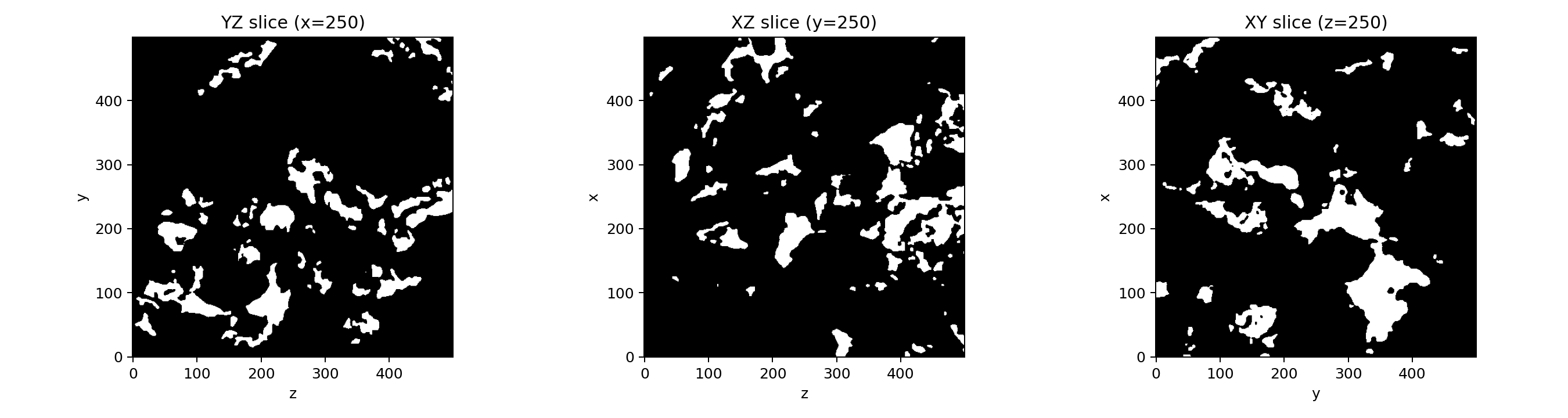
Representative orthogonal slices of the segmented Estaillades volume used in the benchmark.
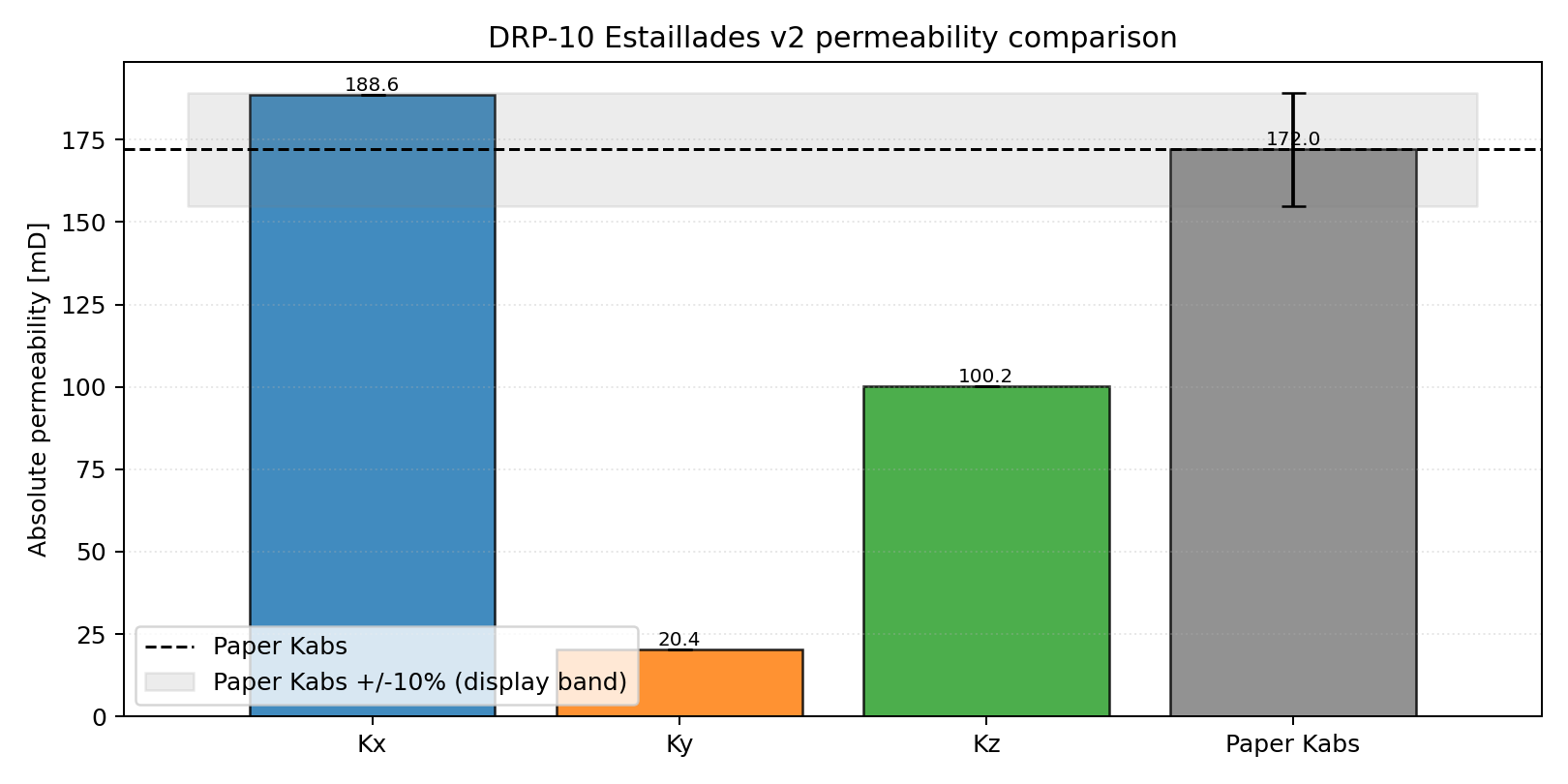
Directional permeability from the current voids run, backend-comparison
workflows, backend mean values, and the paper flow-axis reference (Kx,
Table 2).
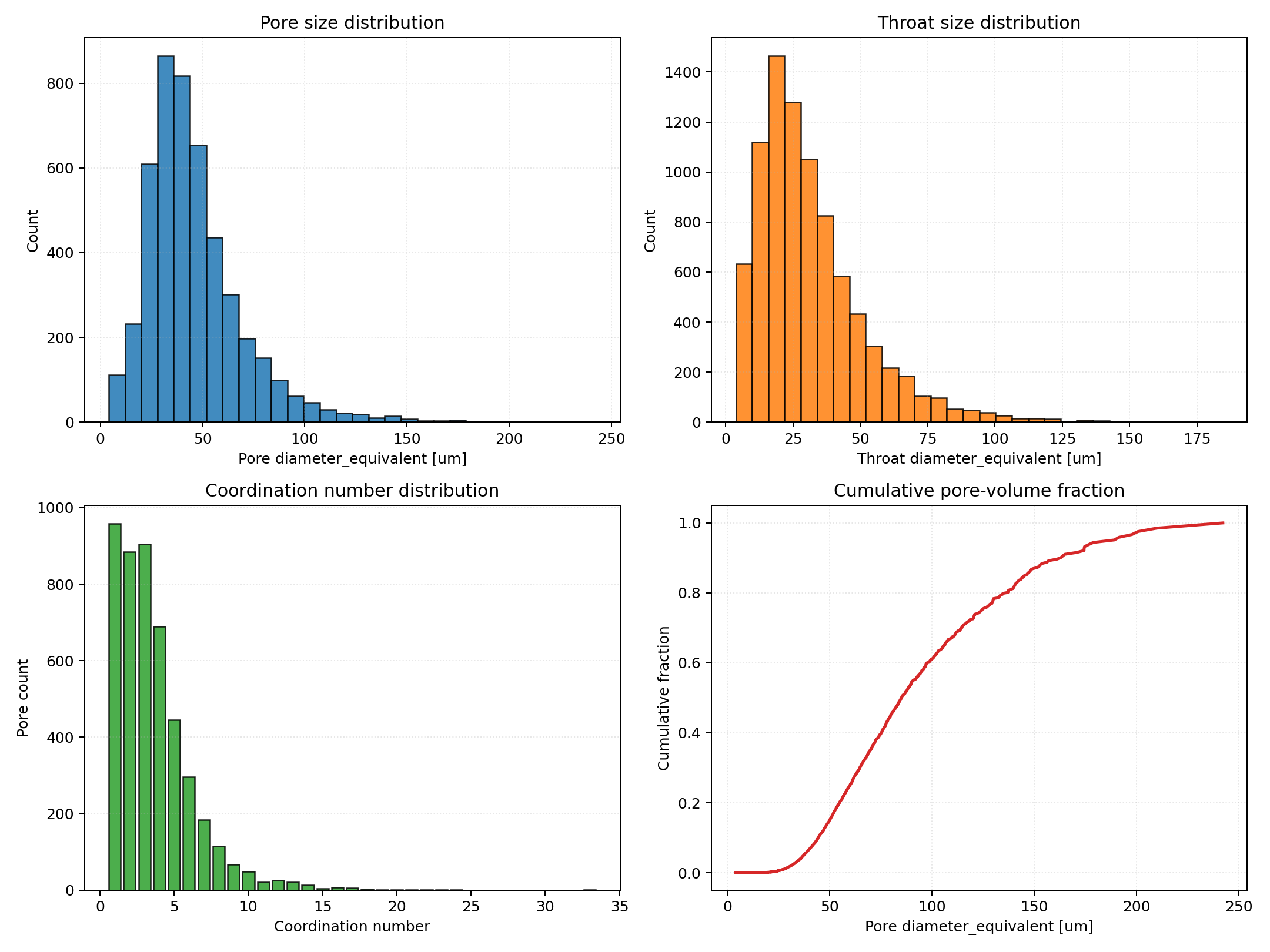
Extracted-network diagnostics for pore/throat counts, size distribution, and topological quality indicators.
Results
The full CSV outputs are available here:
- drp10_estaillades_summary.csv
- drp10_estaillades_directional.csv
- drp10_estaillades_directional_by_backend.csv
- drp10_estaillades_summary_by_backend.csv
Porosity and Permeability Against Paper Reference
| Quantity | voids estimate |
Paper reference | Relative error |
|---|---|---|---|
| Full-image porosity [%] | 10.8180 | 10.8 | +0.17% |
| Network absolute porosity [%] | 10.8180 | 10.8 | +0.17% |
Primary-backend permeability Kx [mD] |
369.8386 | 172.0 | +115.02% |
Directional Permeability By Backend (Current Run)
| Backend | Kx [mD] |
Ky [mD] |
Kz [mD] |
Mean Kabs [mD] |
|---|---|---|---|---|
| Native maximal-ball | 369.84 | 60.40 | 189.90 | 206.71 |
PoreSpy snow2 defaults |
187.81 | 21.12 | 98.15 | 102.36 |
Compatibility-repaired snow2 |
121.92 | 17.91 | 92.44 | 77.43 |
Network Statistics (Current Run)
| Metric | Value |
|---|---|
Np |
2477 |
Nt |
4392 |
| Mean coordination | 3.55 |
| Max coordination | 24 |
| Mean pore diameter-equivalent [um] | 33.77 |
| Mean throat diameter-equivalent [um] | 20.53 |
| Connected components | 1 |
| Giant component fraction | 1.00 |
| Dead-end pore fraction | 0.199 |
Interpretation
The DRP-10 case shows strong agreement in full-image porosity, while the
permeability estimate remains strongly extraction-dependent. The primary native
maximal-ball workflow over-predicts the paper flow-direction permeability in
this snapshot (+115.02% in Kx). The PoreSpy snow2 default comparison is
much closer to the paper Kx value, while the compatibility-repaired snow2
variant is lower.
All three backend configurations preserve the same qualitative anisotropy
(Kx > Kz > Ky), but not the same absolute scale. That spread is expected to
affect which scalar permeability is comparable to a paper-reported directional
value.
For this reason, the current DRP-10 benchmark is best interpreted as workflow-sensitivity evidence under explicit extraction and closure assumptions, not as universal physical calibration.
Limits Of This Verification
Important limits and assumptions:
- single DRP-10 sample (
Estaillades v2) under one current workflow setup - no ROI/subvolume sensitivity analysis in this notebook
- permeability comparison uses paper directionality assumptions from Table 2
- extraction and constitutive choices can shift
Kabsindependently of linear solver correctness - the native maximal-ball extraction is still under active verification against backend-comparison and intermediate-quantity checks
- agreement with one OpenFOAM-referenced paper does not imply agreement with all carbonate datasets or all simulator setups
Reproducible Artifacts
- Notebook:
notebooks/31_mwe_drp10_estaillades_raw_porosity_perm.ipynb - Outputs:
examples/data/drp-10/Estaillades_v2_estimated_properties.csvexamples/data/drp-10/Estaillades_v2_kabs_directional.csvexamples/data/drp-10/Estaillades_v2_kabs_directional_by_backend.csvexamples/data/drp-10/Estaillades_v2_kabs_summary_by_backend.csvexamples/data/drp-10/Estaillades_v2_network_stats.csvexamples/data/drp-10/Estaillades_v2_slices.pngexamples/data/drp-10/Estaillades_v2_kabs_comparison.pngexamples/data/drp-10/Estaillades_v2_network_stats.pngexamples/data/drp-10/Estaillades_v2_network_plotly.html