MWE 15 - External pnextract / pnflow benchmark against voids
This notebook compares voids against a committed reference dataset produced earlier with the
Imperial College pnextract + pnflow workflow. The reference data now lives under
examples/data/external_pnflow_benchmark/, so this notebook does not invoke pnextract or
pnflow and remains runnable even if those binaries are unavailable in the future.
The committed benchmark bundle includes:
- the exact binary input volumes used for the benchmark
pnflowreport files (*_pnflow.prt,*_upscaled.tsv)- extracted-network files (
*_node*.dat,*_link*.dat) for later inspection
Scientific scope and caveats:
- this is an end-to-end workflow comparison, not a solver-only cross-check
- any mismatch reflects both extraction differences and constitutive-model differences
- the voids side is evaluated in three modes:
- import the saved pnextract CNM network, enable explicit
pnflow_solver_box_compat=True, and solve it with voids
- re-extract the saved binary volume with snow2 and solve that network with voids
- re-extract the saved binary volume with the native maximal-ball backend, using explicit
external-reservoir boundary pores on the flow axis, and solve that network with voids
- the external side uses previously saved pnextract geometry plus pnflow's internal
single-phase model
- the CNM compatibility switch is benchmark-specific and reproduces checked-in pnflow
preprocessing, not a generic physical boundary rule for all imported networks
- the committed input volumes make this benchmark stable against future changes in the synthetic
generator implementation
- we keep mu = constant here on purpose because the checked pnflow code path uses scalar fluid
viscosities rather than a thermodynamic mu(P, T) coupling
from __future__ import annotations

import io
import re
from pathlib import Path

import matplotlib.pyplot as plt
import numpy as np
import pandas as pd

from voids.benchmarks import compare_network_geometry
from voids.image import (
    construct_spanning_network,
    extract_maximal_ball_regions,
    summarize_maximal_ball_extraction_diagnostics,
)
from voids.paths import data_path, project_root
from voids.physics.petrophysics import absolute_porosity, effective_porosity
from voids.physics.singlephase import (
    FluidSinglePhase,
    PressureBC,
    SinglePhaseOptions,
    solve,
)


def _render_inline_and_close_figure(fig: object) -> None:
    """Render notebook figures inline while keeping script and CI runs non-interactive."""

    get_ipython_shell = globals().get("get_ipython")
    shell = get_ipython_shell() if callable(get_ipython_shell) else None
    if shell is not None and shell.__class__.__name__ == "ZMQInteractiveShell":
        from IPython.display import Image, display

        figure_buffer = io.BytesIO()
        fig.savefig(figure_buffer, format="png", bbox_inches="tight", dpi=160)
        display(Image(data=figure_buffer.getvalue()))
    plt.close(fig)


def _require_match(pattern: str, text: str, *, label: str) -> re.Match[str]:
    match = re.search(pattern, text, flags=re.MULTILINE)
    if match is None:
        raise ValueError(f"Could not parse {label!r}")
    return match


def _parse_upscaled_metrics(path: Path, *, prefix: str) -> dict[str, float]:
    text = path.read_text()
    permeability = float(
        _require_match(
            rf"{re.escape(prefix)}_permeability:\s*([0-9.eE+-]+);",
            text,
            label=f"{prefix}_permeability",
        ).group(1)
    )
    porosity = float(
        _require_match(
            rf"{re.escape(prefix)}_porosity:\s*([0-9.eE+-]+);",
            text,
            label=f"{prefix}_porosity",
        ).group(1)
    )
    formation_factor = float(
        _require_match(
            rf"{re.escape(prefix)}_formationfactor:\s*([0-9.eE+-]+);",
            text,
            label=f"{prefix}_formationfactor",
        ).group(1)
    )
    return {
        "k_pnflow": permeability,
        "phi_pnflow": porosity,
        "formation_factor_pnflow": formation_factor,
    }


def _parse_pnflow_prt(path: Path) -> dict[str, float | int]:
    text = path.read_text()
    int_patterns = {
        "pnflow_n_pores": r"Number of pores:\s+([0-9]+)",
        "pnflow_n_throats": r"Number of throats:\s+([0-9]+)",
        "pnflow_n_inlet_connections": r"Number of inlet connections:\s+([0-9]+)",
        "pnflow_n_outlet_connections": r"Number of outlet connections:\s+([0-9]+)",
        "pnflow_n_isolated_elements": r"Number of isolated elements:\s+([0-9]+)",
    }
    float_patterns = {
        "phi_pnflow_prt": r"Total porosity:\s+([0-9.eE+-]+)",
        "k_pnflow_prt": r"Absolute permeability:\s+([0-9.eE+-]+)",
    }
    parsed: dict[str, float | int] = {}
    for key, pattern in int_patterns.items():
        value = _require_match(pattern, text, label=key).group(1)
        parsed[key] = int(value)
    for key, pattern in float_patterns.items():
        value = _require_match(pattern, text, label=key).group(1)
        parsed[key] = float(value)
    return parsed


def _load_reference_case(
    reference_root: Path, row: pd.Series
) -> tuple[np.ndarray, dict[str, object]]:
    case = str(row["case"])
    volume = np.load(reference_root / str(row["volume_file"]))
    prt_path = reference_root / str(row["pnflow_prt_file"])
    upscaled_path = reference_root / str(row["pnflow_upscaled_file"])
    metrics: dict[str, object] = {
        **_parse_upscaled_metrics(upscaled_path, prefix=case),
        **_parse_pnflow_prt(prt_path),
        "reference_case_dir": str((reference_root / case).relative_to(project_root())),
    }
    return np.asarray(volume, dtype=bool), metrics


def _construct_voids_from_volume_case(
    volume: np.ndarray,
    *,
    voxel_size: float,
    flow_axis: str,
    backend: str,
    extraction_kwargs: dict[str, object] | None = None,
) -> object:
    return construct_spanning_network(
        backend=backend,
        phases=volume.astype(int),
        voxel_size=voxel_size,
        flow_axis=flow_axis,
        extraction_kwargs=extraction_kwargs,
        provenance_notes={"benchmark_kind": "external_pnflow_reference"},
    )


def _summarize_voids_construction_transport(
    construction: object,
    *,
    flow_axis: str,
    fluid: FluidSinglePhase,
    options: SinglePhaseOptions,
    metric_prefix: str,
) -> dict[str, float | int]:
    image = getattr(construction, "image", None)
    if image is None:
        raise ValueError(
            "Image-based construction is required for volume transport summary"
        )
    bc = PressureBC(
        f"inlet_{flow_axis}min",
        f"outlet_{flow_axis}max",
        pin=2.0e5,
        pout=0.0,
    )
    result = solve(
        construction.net,
        fluid=fluid,
        bc=bc,
        axis=flow_axis,
        options=options,
    )
    helper_pore_mask = _flow_reservoir_helper_pore_mask(
        construction.net, flow_axis=flow_axis
    )
    return {
        "phi_image": float(np.asarray(image, dtype=bool).mean()),
        f"phi_abs_{metric_prefix}_voids": float(absolute_porosity(construction.net)),
        f"phi_eff_{metric_prefix}_voids": float(
            effective_porosity(construction.net, axis=flow_axis)
        ),
        f"Np_{metric_prefix}_voids": int(construction.net.Np),
        f"Np_{metric_prefix}_physical_voids": int(
            construction.net.Np - np.count_nonzero(helper_pore_mask)
        ),
        f"Np_{metric_prefix}_reservoir_helper_voids": int(
            np.count_nonzero(helper_pore_mask)
        ),
        f"Nt_{metric_prefix}_voids": int(construction.net.Nt),
        f"k_{metric_prefix}_voids": float(result.permeability[flow_axis]),
        f"Q_{metric_prefix}_voids": float(result.total_flow_rate),
    }


def _construct_voids_on_imported_cnm_case(
    prefix: Path,
    *,
    flow_axis: str,
) -> object:
    return construct_spanning_network(
        backend="pnflow_cnm",
        pnflow_cnm_prefix=prefix,
        pnflow_solver_box_compat=True,
        flow_axis=flow_axis,
        provenance_notes={"benchmark_kind": "external_pnflow_reference"},
    )


def _summarize_imported_cnm_transport(
    construction: object,
    *,
    flow_axis: str,
    fluid: FluidSinglePhase,
    options: SinglePhaseOptions,
) -> dict[str, float | int]:
    bc = PressureBC(
        f"inlet_{flow_axis}min",
        f"outlet_{flow_axis}max",
        pin=2.0e5,
        pout=0.0,
    )
    result = solve(
        construction.net,
        fluid=fluid,
        bc=bc,
        axis=flow_axis,
        options=options,
    )
    return {
        "phi_abs_imported_voids": float(absolute_porosity(construction.net)),
        "phi_eff_imported_voids": float(
            effective_porosity(construction.net, axis=flow_axis)
        ),
        "Np_imported_physical": int(construction.backend_details["n_physical_pores"]),
        "Np_imported_total": int(construction.net.Np),
        "Np_imported_boundary_mirror": int(
            construction.backend_details["n_boundary_mirror_pores"]
        ),
        "Nt_imported_voids": int(construction.net.Nt),
        "k_imported_voids": float(result.permeability[flow_axis]),
        "Q_imported_voids": float(result.total_flow_rate),
    }


def _geometry_comparison_metrics(
    imported_construction: object,
    candidate_construction: object,
    *,
    flow_axis: str,
    candidate_name: str,
) -> dict[str, float | int]:
    imported_full_net = imported_construction.net_full
    n_physical_pores = int(imported_construction.backend_details["n_physical_pores"])
    imported_physical_mask = (
        np.arange(imported_full_net.Np, dtype=np.int64) < n_physical_pores
    )
    candidate_helper_mask = _flow_reservoir_helper_pore_mask(
        candidate_construction.net_full,
        flow_axis=flow_axis,
    )
    candidate_physical_mask = (
        ~candidate_helper_mask if np.any(candidate_helper_mask) else None
    )
    comparison = compare_network_geometry(
        imported_full_net,
        candidate_construction.net_full,
        axis=flow_axis,
        reference_pore_mask=imported_physical_mask,
        candidate_pore_mask=candidate_physical_mask,
        reference_name="imported_physical",
        candidate_name=candidate_name,
    )
    return {
        f"{candidate_name}_geom_pore_count_rel_diff": float(
            comparison.pore_count_rel_diff
        ),
        f"{candidate_name}_geom_throat_count_rel_diff": float(
            comparison.throat_count_rel_diff
        ),
        f"{candidate_name}_geom_mean_coordination_rel_diff": float(
            comparison.mean_coordination_rel_diff
        ),
        f"{candidate_name}_geom_pore_radius_ks": float(comparison.pore_radius_ks),
        f"{candidate_name}_geom_throat_radius_ks": float(comparison.throat_radius_ks),
        f"{candidate_name}_geom_throat_area_ks": float(comparison.throat_area_ks),
        f"{candidate_name}_geom_throat_length_ks": float(comparison.throat_length_ks),
        f"{candidate_name}_geom_throat_core_length_ks": float(
            comparison.throat_core_length_ks
        ),
        f"{candidate_name}_geom_coordination_ks": float(comparison.coordination_ks),
        f"{candidate_name}_geom_throat_face_count_ks": float(
            comparison.throat_face_count_ks
        ),
        f"{candidate_name}_geom_n_components": int(
            comparison.candidate_summary.n_components
        ),
        f"{candidate_name}_geom_dead_end_fraction": float(
            comparison.candidate_summary.dead_end_fraction
        ),
        f"{candidate_name}_geom_overlap_boundary_count": int(
            comparison.candidate_summary.overlapping_boundary_count
        ),
        f"{candidate_name}_geom_support_radius_mean": float(
            comparison.candidate_summary.throat_support_radius_mean
        ),
    }


def _flow_reservoir_helper_pore_mask(net: object, *, flow_axis: str) -> np.ndarray:
    """Return helper reservoir pores, if the extraction backend created them."""

    pore_count = int(getattr(net, "Np"))
    pore_labels = getattr(net, "pore_labels", {})
    helper_mask = np.zeros(pore_count, dtype=bool)
    for side_name in ("min", "max"):
        connected_key = (
            f"boundary_connected_inlet_{flow_axis}{side_name}"
            if side_name == "min"
            else f"boundary_connected_outlet_{flow_axis}{side_name}"
        )
        helper_key = (
            f"inlet_{flow_axis}{side_name}"
            if side_name == "min"
            else f"outlet_{flow_axis}{side_name}"
        )
        if connected_key in pore_labels and helper_key in pore_labels:
            helper_mask |= np.asarray(pore_labels[helper_key], dtype=bool)
    return helper_mask


def _maximal_ball_step_diagnostics_metrics(
    volume: np.ndarray,
    *,
    distance_map_backend: str,
) -> dict[str, float | int]:
    """Summarize native maximal-ball extraction stages for per-case benchmarking."""

    extraction_result = extract_maximal_ball_regions(
        volume,
        distance_map_backend=distance_map_backend,
    )
    diagnostics = summarize_maximal_ball_extraction_diagnostics(
        volume,
        extraction_result,
    )
    return {
        "maxball_diag_retained_ball_count": int(diagnostics.retained_ball_count),
        "maxball_diag_root_region_count": int(diagnostics.root_region_count),
        "maxball_diag_occupied_region_count": int(diagnostics.occupied_region_count),
        "maxball_diag_assigned_void_fraction": float(
            diagnostics.assigned_void_fraction
        ),
        "maxball_diag_unassigned_void_voxel_count": int(
            diagnostics.unassigned_void_voxel_count
        ),
        "maxball_diag_zero_throat_region_count": int(
            diagnostics.zero_throat_region_count
        ),
        "maxball_diag_internal_zero_throat_region_count": int(
            diagnostics.internal_zero_throat_region_count
        ),
        "maxball_diag_boundary_zero_throat_region_count": int(
            diagnostics.boundary_zero_throat_region_count
        ),
        "maxball_diag_touch_radius_side1_mean_voxels": float(
            diagnostics.throat_touch_radius_side1_mean_voxels
        ),
        "maxball_diag_touch_radius_side2_mean_voxels": float(
            diagnostics.throat_touch_radius_side2_mean_voxels
        ),
        "maxball_diag_refined_support_radius_side1_mean_voxels": float(
            diagnostics.throat_refined_support_radius_side1_mean_voxels
        ),
        "maxball_diag_refined_support_radius_side2_mean_voxels": float(
            diagnostics.throat_refined_support_radius_side2_mean_voxels
        ),
    }


def _make_permeability_comparison_figure(
    summary_frame: pd.DataFrame,
    *,
    output_path: Path,
) -> None:
    fig, axes = plt.subplots(1, 2, figsize=(13, 4.5))

    kmin = float(
        min(
            summary_frame["k_imported_voids"].min(),
            summary_frame["k_porespy_voids"].min(),
            summary_frame["k_maxball_voids"].min(),
            summary_frame["k_pnflow"].min(),
        )
    )
    kmax = float(
        max(
            summary_frame["k_imported_voids"].max(),
            summary_frame["k_porespy_voids"].max(),
            summary_frame["k_maxball_voids"].max(),
            summary_frame["k_pnflow"].max(),
        )
    )
    pad = 0.05 * max(kmax - kmin, 1.0e-30)

    axes[0].scatter(
        summary_frame["k_pnflow"],
        summary_frame["k_imported_voids"],
        s=65,
        color="tab:green",
        label="voids on imported pnextract CNM",
    )
    axes[0].scatter(
        summary_frame["k_pnflow"],
        summary_frame["k_porespy_voids"],
        s=65,
        color="tab:blue",
        label="voids on PoreSpy extraction",
    )
    axes[0].scatter(
        summary_frame["k_pnflow"],
        summary_frame["k_maxball_voids"],
        s=65,
        color="tab:red",
        label="voids on native maximal-ball extraction",
    )
    axes[0].plot(
        [kmin - pad, kmax + pad],
        [kmin - pad, kmax + pad],
        color="black",
        lw=1.2,
        linestyle="--",
    )
    for row in summary_frame.itertuples(index=False):
        axes[0].annotate(
            row.case,
            (row.k_pnflow, row.k_imported_voids),
            textcoords="offset points",
            xytext=(5, 4),
            fontsize=8,
        )
    axes[0].set_xlabel("pnflow permeability [m$^2$]")
    axes[0].set_ylabel("voids permeability [m$^2$]")
    axes[0].set_title("Permeability scatter")
    axes[0].legend()

    x = np.arange(len(summary_frame))
    width = 0.26
    axes[1].bar(
        x - width,
        100.0 * summary_frame["k_rel_diff_imported"],
        width=width,
        color="tab:green",
        label="imported CNM",
    )
    axes[1].bar(
        x,
        100.0 * summary_frame["k_rel_diff_porespy"],
        width=width,
        color="tab:orange",
        label="PoreSpy extraction",
    )
    axes[1].bar(
        x + width,
        100.0 * summary_frame["k_rel_diff_maxball"],
        width=width,
        color="tab:red",
        label="native maximal-ball extraction",
    )
    axes[1].set_xticks(x, summary_frame["case"], rotation=25)
    axes[1].set_xlabel("case")
    axes[1].set_ylabel("relative difference [%]")
    axes[1].set_title("Per-case permeability mismatch")
    axes[1].legend()

    fig.suptitle("External pnflow benchmark", fontsize=13)
    plt.tight_layout()
    fig.savefig(output_path, dpi=160, bbox_inches="tight")
    _render_inline_and_close_figure(fig)


def _make_porosity_trend_figure(
    summary_frame: pd.DataFrame,
    *,
    output_path: Path,
) -> None:
    plot_df = summary_frame.sort_values(["phi_image", "blobiness"]).copy()
    fig, ax = plt.subplots(figsize=(7.5, 4.8))

    ax.semilogy(
        plot_df["phi_image"],
        plot_df["k_pnflow"],
        marker="o",
        lw=1.5,
        label="pnflow",
    )
    ax.semilogy(
        plot_df["phi_image"],
        plot_df["k_imported_voids"],
        marker="^",
        lw=1.5,
        label="voids on imported pnextract CNM",
    )
    ax.semilogy(
        plot_df["phi_image"],
        plot_df["k_porespy_voids"],
        marker="s",
        lw=1.5,
        label="voids on PoreSpy extraction",
    )
    ax.semilogy(
        plot_df["phi_image"],
        plot_df["k_maxball_voids"],
        marker="D",
        lw=1.5,
        label="voids on native maximal-ball extraction",
    )
    ax.set_xlabel("image porosity [-]")
    ax.set_ylabel("permeability [m$^2$]")
    ax.set_title("Permeability trend with porosity")
    ax.grid(True, which="both", alpha=0.3)
    ax.legend()

    plt.tight_layout()
    fig.savefig(output_path, dpi=160, bbox_inches="tight")
    _render_inline_and_close_figure(fig)


examples_data = data_path()
reference_root = examples_data / "external_pnflow_benchmark"
manifest_path = reference_root / "manifest.csv"
report_dir = project_root() / "docs" / "assets" / "verification"
report_dir.mkdir(parents=True, exist_ok=True)
report_csv = report_dir / "pnflow_5_case_results.csv"
maxball_diagnostics_csv = report_dir / "pnflow_maxball_step_diagnostics.csv"
comparison_figure_path = report_dir / "pnflow_permeability_scatter_and_error.png"
porosity_figure_path = report_dir / "pnflow_porosity_vs_permeability.png"

if not manifest_path.exists():
    raise FileNotFoundError(
        "Committed reference data not found. Expected " f"{manifest_path} to exist."
    )

fluid = FluidSinglePhase(viscosity=1.0e-3)
options = SinglePhaseOptions(
    conductance_model="valvatne_blunt",
    solver="direct",
)
manifest_df = pd.read_csv(manifest_path)
Reference dataset provenance
The table below is the committed benchmark manifest. The notebook loads the exact saved volumes
and previously generated pnflow reports from examples/data/external_pnflow_benchmark/.
| case | shape | porosity_target | blobiness | seed_start | seed_used | flow_axis | voxel_size_m | volume_file | pnflow_prt_file | pnflow_upscaled_file | |
|---|---|---|---|---|---|---|---|---|---|---|---|
| 0 | phi032_b14 | 32x32x32 | 0.32 | 1.4 | 401 | 401 | x | 0.000002 | phi032_b14/void_volume.npy | phi032_b14/phi032_b14_pnflow.prt | phi032_b14/phi032_b14_upscaled.tsv |
| 1 | phi035_b16 | 32x32x32 | 0.35 | 1.6 | 501 | 501 | x | 0.000002 | phi035_b16/void_volume.npy | phi035_b16/phi035_b16_pnflow.prt | phi035_b16/phi035_b16_upscaled.tsv |
| 2 | phi038_b18 | 32x32x32 | 0.38 | 1.8 | 601 | 601 | x | 0.000002 | phi038_b18/void_volume.npy | phi038_b18/phi038_b18_pnflow.prt | phi038_b18/phi038_b18_upscaled.tsv |
| 3 | phi040_b18 | 32x32x32 | 0.40 | 1.8 | 901 | 901 | x | 0.000002 | phi040_b18/void_volume.npy | phi040_b18/phi040_b18_pnflow.prt | phi040_b18/phi040_b18_upscaled.tsv |
| 4 | phi041_b20 | 32x32x32 | 0.41 | 2.0 | 701 | 701 | x | 0.000002 | phi041_b20/void_volume.npy | phi041_b20/phi041_b20_pnflow.prt | phi041_b20/phi041_b20_upscaled.tsv |
Representative benchmark input
The committed input volumes are binary segmented images (True = void) that were used in the
original external pnextract / pnflow run.
representative_row = manifest_df.loc[manifest_df["case"] == "phi038_b18"].iloc[0]
representative_volume = np.load(
    reference_root / representative_row["volume_file"]
).astype(bool)
mid = representative_volume.shape[0] // 2

fig, axes = plt.subplots(1, 3, figsize=(15, 4))
axes[0].imshow(representative_volume[mid, :, :], cmap="gray", origin="lower")
axes[0].set_title("YZ slice")
axes[0].set_xlabel("z")
axes[0].set_ylabel("y")

axes[1].imshow(representative_volume[:, mid, :], cmap="gray", origin="lower")
axes[1].set_title("XZ slice")
axes[1].set_xlabel("z")
axes[1].set_ylabel("x")

axes[2].imshow(representative_volume[:, :, mid], cmap="gray", origin="lower")
axes[2].set_title("XY slice")
axes[2].set_xlabel("y")
axes[2].set_ylabel("x")

fig.suptitle(
    f"Representative committed input: {representative_row['case']}", fontsize=13
)
plt.tight_layout()
_render_inline_and_close_figure(fig)

print("shape =", representative_volume.shape)
print("void fraction =", float(representative_volume.mean()))
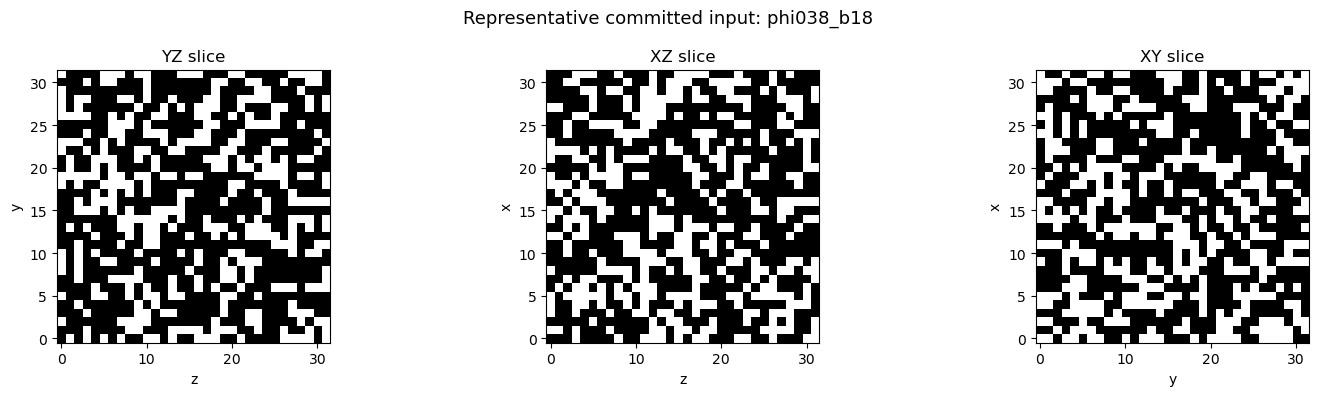
shape = (32, 32, 32)
void fraction = 0.3800048828125
Run voids against the committed external references
For each case, the notebook loads the saved external outputs and then evaluates three voids
pathways:
- imported CNM: reuse the saved
pnextractnetwork and compare thevoidssingle-phase solve directly againstpnflow - image extraction with
snow2: re-extract the saved binary volume with the currentvoidssnow2workflow and compare that full path againstpnflow - image extraction with native maximal-ball: run the current
voidsmaximal-ball path with explicit external-reservoir boundary pores and compare that full path againstpnflow
This split helps identify whether a mismatch is dominated by extraction or by the single-phase solver/geometry interpretation on the same network.
rows: list[dict[str, object]] = []

for row in manifest_df.itertuples(index=False):
    row_series = pd.Series(row._asdict())
    volume, pnflow_metrics = _load_reference_case(reference_root, row_series)
    case_root = reference_root / str(row_series["case"])
    imported_construction = _construct_voids_on_imported_cnm_case(
        case_root / str(row_series["case"]),
        flow_axis=str(row_series["flow_axis"]),
    )
    imported_metrics = _summarize_imported_cnm_transport(
        imported_construction,
        flow_axis=str(row_series["flow_axis"]),
        fluid=fluid,
        options=options,
    )
    porespy_construction = _construct_voids_from_volume_case(
        volume,
        voxel_size=float(row_series["voxel_size_m"]),
        flow_axis=str(row_series["flow_axis"]),
        backend="porespy",
    )
    porespy_metrics = _summarize_voids_construction_transport(
        porespy_construction,
        flow_axis=str(row_series["flow_axis"]),
        fluid=fluid,
        options=options,
        metric_prefix="porespy",
    )
    maxball_construction = _construct_voids_from_volume_case(
        volume,
        voxel_size=float(row_series["voxel_size_m"]),
        flow_axis=str(row_series["flow_axis"]),
        backend="native_maximal_ball",
        extraction_kwargs={
            "distance_map_backend": "scipy",
            "flow_boundary_mode": "external_reservoir",
        },
    )
    maxball_metrics = _summarize_voids_construction_transport(
        maxball_construction,
        flow_axis=str(row_series["flow_axis"]),
        fluid=fluid,
        options=options,
        metric_prefix="maxball",
    )
    porespy_geometry_metrics = _geometry_comparison_metrics(
        imported_construction,
        porespy_construction,
        flow_axis=str(row_series["flow_axis"]),
        candidate_name="porespy",
    )
    maxball_geometry_metrics = _geometry_comparison_metrics(
        imported_construction,
        maxball_construction,
        flow_axis=str(row_series["flow_axis"]),
        candidate_name="maxball",
    )
    maxball_step_diagnostics = _maximal_ball_step_diagnostics_metrics(
        volume,
        distance_map_backend="scipy",
    )
    rows.append(
        {
            **row._asdict(),
            **pnflow_metrics,
            **imported_metrics,
            **porespy_metrics,
            **maxball_metrics,
            **porespy_geometry_metrics,
            **maxball_geometry_metrics,
            **maxball_step_diagnostics,
        }
    )

summary_df = pd.DataFrame(rows)
summary_df["k_ratio_imported_to_pnflow"] = (
    summary_df["k_imported_voids"] / summary_df["k_pnflow"]
)
summary_df["k_ratio_porespy_to_pnflow"] = (
    summary_df["k_porespy_voids"] / summary_df["k_pnflow"]
)
summary_df["k_ratio_maxball_to_pnflow"] = (
    summary_df["k_maxball_voids"] / summary_df["k_pnflow"]
)
summary_df["k_rel_diff_imported"] = np.abs(
    summary_df["k_imported_voids"] - summary_df["k_pnflow"]
) / np.maximum(
    np.maximum(np.abs(summary_df["k_imported_voids"]), np.abs(summary_df["k_pnflow"])),
    1.0e-30,
)
summary_df["k_rel_diff_porespy"] = np.abs(
    summary_df["k_porespy_voids"] - summary_df["k_pnflow"]
) / np.maximum(
    np.maximum(np.abs(summary_df["k_porespy_voids"]), np.abs(summary_df["k_pnflow"])),
    1.0e-30,
)
summary_df["k_rel_diff_maxball"] = np.abs(
    summary_df["k_maxball_voids"] - summary_df["k_pnflow"]
) / np.maximum(
    np.maximum(np.abs(summary_df["k_maxball_voids"]), np.abs(summary_df["k_pnflow"])),
    1.0e-30,
)
summary_df["phi_abs_diff_imported"] = (
    summary_df["phi_abs_imported_voids"] - summary_df["phi_pnflow"]
)
summary_df["phi_abs_diff_porespy"] = (
    summary_df["phi_abs_porespy_voids"] - summary_df["phi_pnflow"]
)
summary_df["phi_abs_diff_maxball"] = (
    summary_df["phi_abs_maxball_voids"] - summary_df["phi_pnflow"]
)
summary_df["np_rel_diff_imported"] = np.abs(
    summary_df["Np_imported_physical"] - summary_df["pnflow_n_pores"]
) / np.maximum(summary_df["pnflow_n_pores"], 1.0)
summary_df["np_rel_diff_porespy"] = np.abs(
    summary_df["Np_porespy_physical_voids"] - summary_df["pnflow_n_pores"]
) / np.maximum(summary_df["pnflow_n_pores"], 1.0)
summary_df["nt_rel_diff_imported"] = np.abs(
    summary_df["Nt_imported_voids"] - summary_df["pnflow_n_throats"]
) / np.maximum(summary_df["pnflow_n_throats"], 1.0)
summary_df["nt_rel_diff_porespy"] = np.abs(
    summary_df["Nt_porespy_voids"] - summary_df["pnflow_n_throats"]
) / np.maximum(summary_df["pnflow_n_throats"], 1.0)
summary_df["np_rel_diff_maxball"] = np.abs(
    summary_df["Np_maxball_physical_voids"] - summary_df["pnflow_n_pores"]
) / np.maximum(summary_df["pnflow_n_pores"], 1.0)
summary_df["nt_rel_diff_maxball"] = np.abs(
    summary_df["Nt_maxball_voids"] - summary_df["pnflow_n_throats"]
) / np.maximum(summary_df["pnflow_n_throats"], 1.0)

display_columns = [
    "case",
    "seed_used",
    "porosity_target",
    "blobiness",
    "phi_image",
    "phi_abs_imported_voids",
    "phi_abs_porespy_voids",
    "phi_abs_maxball_voids",
    "phi_pnflow",
    "Np_imported_physical",
    "Np_porespy_physical_voids",
    "Np_porespy_reservoir_helper_voids",
    "Np_porespy_voids",
    "Np_maxball_physical_voids",
    "Np_maxball_reservoir_helper_voids",
    "Np_maxball_voids",
    "pnflow_n_pores",
    "Nt_imported_voids",
    "Nt_porespy_voids",
    "Nt_maxball_voids",
    "pnflow_n_throats",
    "k_imported_voids",
    "k_porespy_voids",
    "k_maxball_voids",
    "k_pnflow",
    "k_rel_diff_imported",
    "k_rel_diff_porespy",
    "k_rel_diff_maxball",
    "porespy_geom_pore_count_rel_diff",
    "porespy_geom_throat_count_rel_diff",
    "porespy_geom_throat_radius_ks",
    "porespy_geom_coordination_ks",
    "porespy_geom_n_components",
    "maxball_geom_pore_count_rel_diff",
    "maxball_geom_throat_count_rel_diff",
    "maxball_geom_throat_radius_ks",
    "maxball_geom_coordination_ks",
    "maxball_geom_n_components",
    "maxball_geom_dead_end_fraction",
    "maxball_diag_assigned_void_fraction",
    "maxball_diag_unassigned_void_voxel_count",
    "maxball_diag_zero_throat_region_count",
    "maxball_diag_internal_zero_throat_region_count",
]
summary_df.loc[:, display_columns]
| case | seed_used | porosity_target | blobiness | phi_image | phi_abs_imported_voids | phi_abs_porespy_voids | phi_abs_maxball_voids | phi_pnflow | Np_imported_physical | ... | maxball_geom_pore_count_rel_diff | maxball_geom_throat_count_rel_diff | maxball_geom_throat_radius_ks | maxball_geom_coordination_ks | maxball_geom_n_components | maxball_geom_dead_end_fraction | maxball_diag_assigned_void_fraction | maxball_diag_unassigned_void_voxel_count | maxball_diag_zero_throat_region_count | maxball_diag_internal_zero_throat_region_count | |
|---|---|---|---|---|---|---|---|---|---|---|---|---|---|---|---|---|---|---|---|---|---|
| 0 | phi032_b14 | 401 | 0.32 | 1.4 | 0.320007 | 0.276611 | 0.320190 | 0.280884 | 0.275787 | 80 | ... | 0.024390 | 0.029412 | 0.806061 | 0.072561 | 3 | 0.121951 | 0.910357 | 940 | 1 | 0 |
| 1 | phi035_b16 | 501 | 0.35 | 1.6 | 0.350006 | 0.297089 | 0.349762 | 0.311859 | 0.295502 | 71 | ... | 0.014085 | 0.029940 | 0.814371 | 0.053521 | 1 | 0.100000 | 0.891011 | 1250 | 0 | 0 |
| 2 | phi038_b18 | 601 | 0.38 | 1.8 | 0.380005 | 0.322083 | 0.380005 | 0.336761 | 0.316315 | 64 | ... | 0.072464 | 0.058065 | 0.835616 | 0.068388 | 2 | 0.072464 | 0.887006 | 1407 | 1 | 0 |
| 3 | phi040_b18 | 901 | 0.40 | 1.8 | 0.399994 | 0.346832 | 0.399994 | 0.365234 | 0.343414 | 83 | ... | 0.011905 | 0.020000 | 0.897959 | 0.068273 | 2 | 0.071429 | 0.915618 | 1106 | 0 | 0 |
| 4 | phi041_b20 | 701 | 0.41 | 2.0 | 0.410004 | 0.354492 | 0.410004 | 0.369812 | 0.354004 | 72 | ... | 0.013889 | 0.027778 | 0.879630 | 0.067097 | 2 | 0.000000 | 0.904429 | 1284 | 1 | 0 |
5 rows × 43 columns
diagnostic_summary_columns = [
    "k_rel_diff_imported",
    "k_rel_diff_porespy",
    "k_rel_diff_maxball",
    "porespy_geom_pore_count_rel_diff",
    "porespy_geom_throat_count_rel_diff",
    "porespy_geom_coordination_ks",
    "porespy_geom_n_components",
    "maxball_geom_pore_count_rel_diff",
    "maxball_geom_throat_count_rel_diff",
    "maxball_geom_throat_radius_ks",
    "maxball_geom_coordination_ks",
    "maxball_geom_n_components",
    "maxball_geom_dead_end_fraction",
    "maxball_diag_assigned_void_fraction",
    "maxball_diag_zero_throat_region_count",
    "maxball_diag_internal_zero_throat_region_count",
]
summary_df.loc[:, diagnostic_summary_columns].mean(numeric_only=True).to_frame(
    name="mean_over_cases"
)
| mean_over_cases | |
|---|---|
| k_rel_diff_imported | 0.000001 |
| k_rel_diff_porespy | 0.375629 |
| k_rel_diff_maxball | 0.149495 |
| porespy_geom_pore_count_rel_diff | 0.467732 |
| porespy_geom_throat_count_rel_diff | 0.370830 |
| porespy_geom_coordination_ks | 0.221289 |
| porespy_geom_n_components | 1.200000 |
| maxball_geom_pore_count_rel_diff | 0.027346 |
| maxball_geom_throat_count_rel_diff | 0.033039 |
| maxball_geom_throat_radius_ks | 0.846727 |
| maxball_geom_coordination_ks | 0.065968 |
| maxball_geom_n_components | 2.000000 |
| maxball_geom_dead_end_fraction | 0.073169 |
| maxball_diag_assigned_void_fraction | 0.901684 |
| maxball_diag_zero_throat_region_count | 0.600000 |
| maxball_diag_internal_zero_throat_region_count | 0.000000 |
Save derived comparison artifacts
The committed external reference data under examples/data/ are treated as inputs. The CSV and
figures written here remain derived benchmark reports for documentation and review.
Saved: /Users/dtvolpatto/Work/voids/docs/assets/verification/pnflow_5_case_results.csv
maxball_step_diagnostic_columns = [
    "case",
    "maxball_diag_retained_ball_count",
    "maxball_diag_root_region_count",
    "maxball_diag_occupied_region_count",
    "maxball_diag_assigned_void_fraction",
    "maxball_diag_unassigned_void_voxel_count",
    "maxball_diag_zero_throat_region_count",
    "maxball_diag_internal_zero_throat_region_count",
    "maxball_diag_boundary_zero_throat_region_count",
    "maxball_diag_touch_radius_side1_mean_voxels",
    "maxball_diag_touch_radius_side2_mean_voxels",
    "maxball_diag_refined_support_radius_side1_mean_voxels",
    "maxball_diag_refined_support_radius_side2_mean_voxels",
]
summary_df.loc[:, maxball_step_diagnostic_columns].to_csv(
    maxball_diagnostics_csv,
    index=False,
)
print("Saved:", maxball_diagnostics_csv)
Saved: /Users/dtvolpatto/Work/voids/docs/assets/verification/pnflow_maxball_step_diagnostics.csv
_make_permeability_comparison_figure(
    summary_df,
    output_path=comparison_figure_path,
)
print("Saved:", comparison_figure_path)
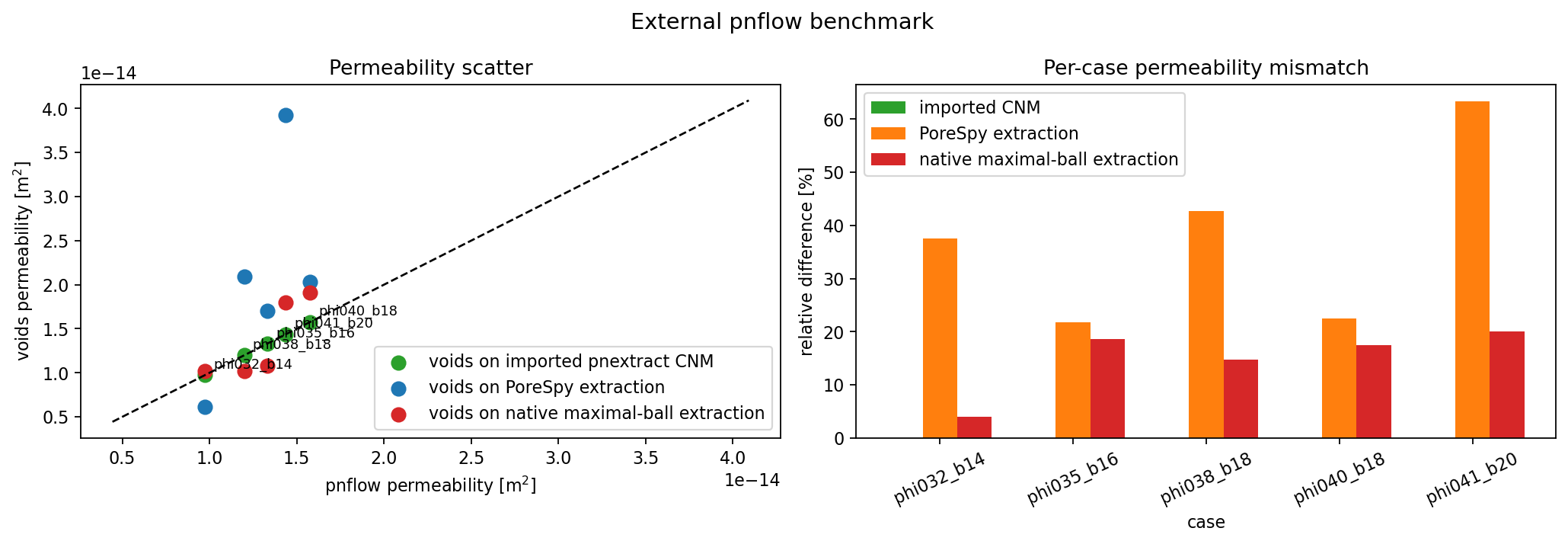
Saved: /Users/dtvolpatto/Work/voids/docs/assets/verification/pnflow_permeability_scatter_and_error.png
_make_porosity_trend_figure(
    summary_df,
    output_path=porosity_figure_path,
)
print("Saved:", porosity_figure_path)
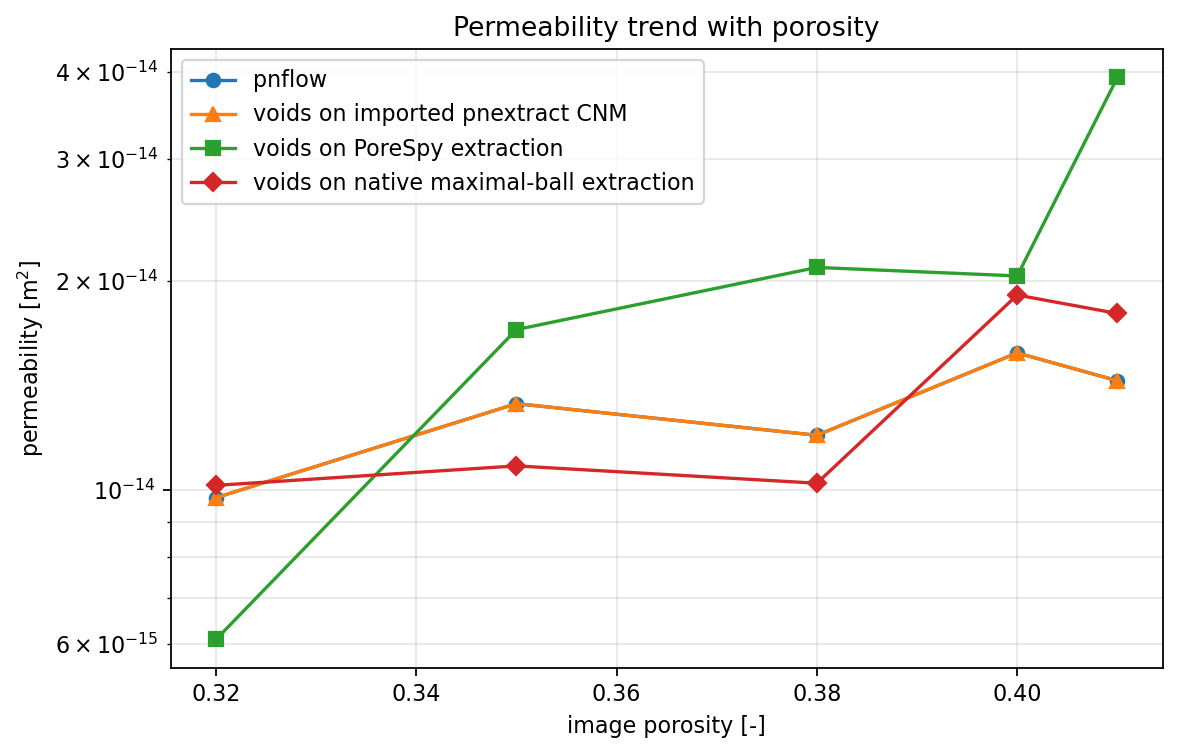
Saved: /Users/dtvolpatto/Work/voids/docs/assets/verification/pnflow_porosity_vs_permeability.png
Interpretation
The permeability comparison is the main benchmark output. The porosity and network-size columns
help diagnose whether a mismatch comes primarily from extraction topology, pore/throat geometry,
or the transport model itself. The added geometry columns compare each voids extraction against
the imported physical pnextract CNM rather than only against the final pnflow permeability.
Points to keep in mind when interpreting the numbers:
- pnflow reports porosity after its own extracted-network construction, not the binary-image
void fraction
- imported-CNM and PoreSpy-extracted voids porosities are not identical diagnostics:
the imported CNM includes the saved pnextract conduit volumes, while the PoreSpy path uses
the current voids extraction and pruning workflow
- if imported-CNM permeability is much closer to pnflow than both image-extraction paths, the
dominant remaining mismatch is likely extraction rather than the single-phase solver itself
- large throat-count relative error, large throat-radius KS distance, or many disconnected
components in the candidate extraction are stronger evidence of topology/ownership mismatch than
of a boundary-condition or transport-model issue
- at the current stage, the native maximal-ball path should be treated as a topology diagnostic:
it now uses explicit external-reservoir boundary pores on the flow axis and is closer than
snow2 on mean permeability error for this five-case set; after excluding helper reservoir
pores from geometry diagnostics, the residual mismatch is more concentrated in conduit
area/shape-factor and boundary-reservoir reduction than in physical pore/throat counts
- a close permeability match on the imported CNM is encouraging, but it still does not prove full
geometric equivalence between implementations
- a large mismatch is not automatically a bug in voids; it may reflect different extraction and
conductance assumptions in the two workflows