DRP-317 Bentheimer Notebook Report
Notebook: 19_mwe_drp317_bentheimer_raw_porosity_perm
Sources
- Dataset: Neumann, R., ANDREETA, M., Lucas-Oliveira, E. (2020, October 7). 11 Sandstones: raw, filtered and segmented data [Dataset]. Digital Porous Media Portal. https://www.doi.org/10.17612/f4h1-w124
- Experimental reference paper: Neumann, R. F., Barsi-Andreeta, M., Lucas-Oliveira, E., Barbalho, H., Trevizan, W. A., Bonagamba, T. J., & Steiner, M. B. (2021). High accuracy capillary network representation in digital rock reveals permeability scaling functions. Scientific Reports, 11, 11370. https://doi.org/10.1038/s41598-021-90090-0
Current Setup
- Raw volume:
Bentheimer_2d25um_binary.raw - ROI size:
(300, 300, 300)voxels - Selected ROI origin:
(0, 0, 700) - ROI porosity:
26.75% - Extraction backends:
porespy,prego,native_maximal_ball - Primary reported conductance model:
generic_poiseuille - Conductance-model audit:
generic_poiseuille,hagen_poiseuille,valvatne_blunt, andautoon the same extracted networks - PoreSpy/PREGO boundary and transport geometry: external-reservoir helper pores
with generated pyramids-and-cuboids hydraulic size factors available to
auto - Viscosity model: tabulated water viscosity from
thermo,298.15 K - Boundary pressures:
pout = 5.0 MPa,pin = pout + 10 kPa/m * L
Key Results
| Quantity | Value |
|---|---|
| Experimental porosity [%] | 22.64 |
| Full-image porosity [%] | 26.72 |
| ROI porosity [%] | 26.75 |
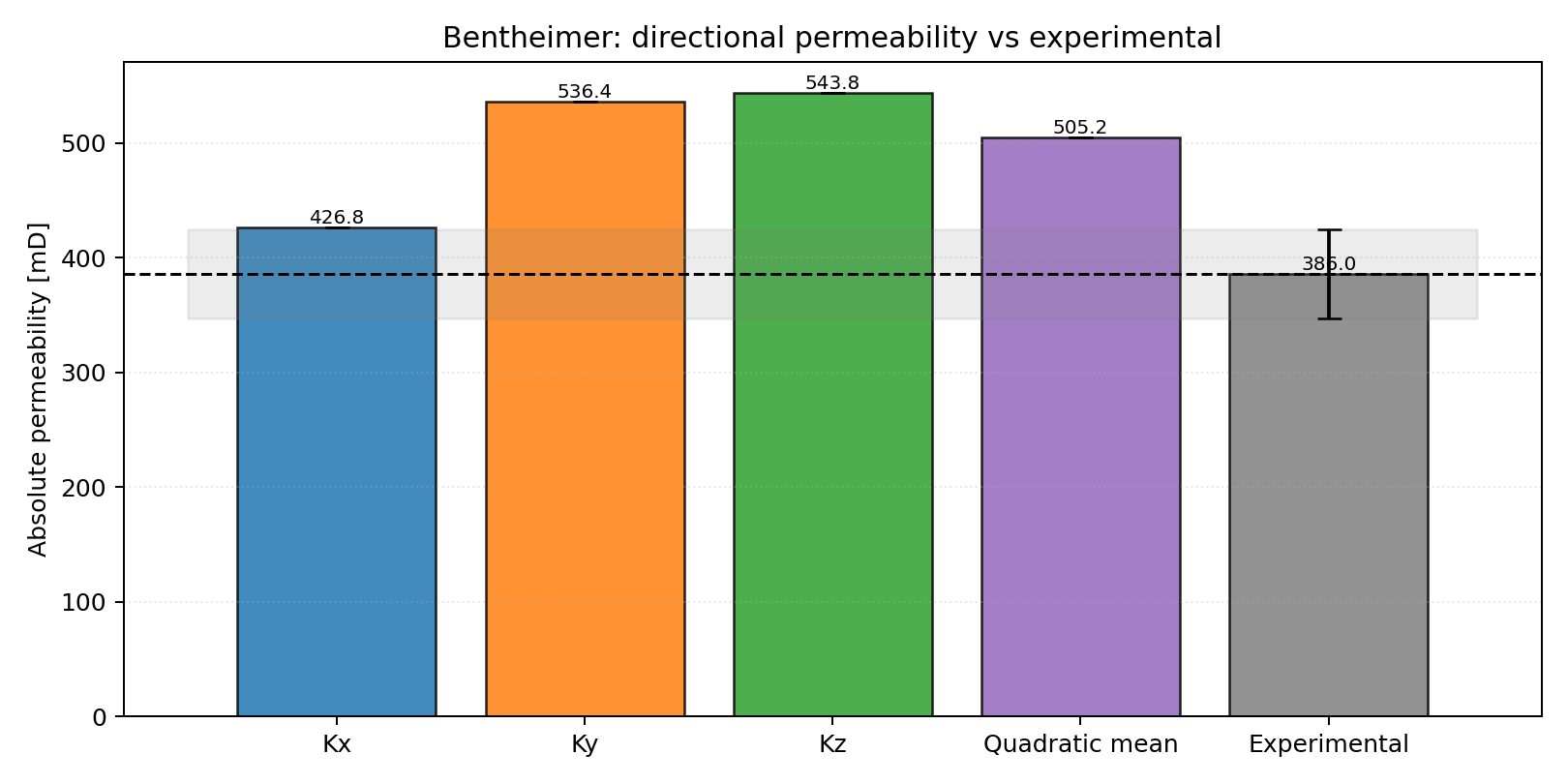
| Experimental permeability [mD] | 386.0 |
| Backend | Network phi [%] | Kx [mD] | Ky [mD] | Kz [mD] | RMS K [mD] | Rel. K error [%] | Np | Nt |
|---|---|---|---|---|---|---|---|---|
| PoreSpy snow2 | 27.57 | 409.55 | 495.34 | 485.67 | 465.11 | 20.49 | 3179 | 5193 |
| PREGO | 26.53 | 779.42 | 926.15 | 920.10 | 877.84 | 127.42 | 2119 | 4926 |
| Native maximal-ball | 26.53 | 218.22 | 315.43 | 330.66 | 292.38 | -24.25 | 1126 | 2130 |
Network Statistics Snapshot
| Backend | Mean coordination | Dead-end pore fraction |
|---|---|---|
| PoreSpy snow2 | 3.27 | 0.361 |
| PREGO | 4.65 | 0.181 |
| Native maximal-ball | 3.78 | 0.219 |
Conductance-Model Audit
| Backend | generic [mD] | Hagen-Poiseuille [mD] | Valvatne-Blunt [mD] | auto [mD] |
|---|---|---|---|---|
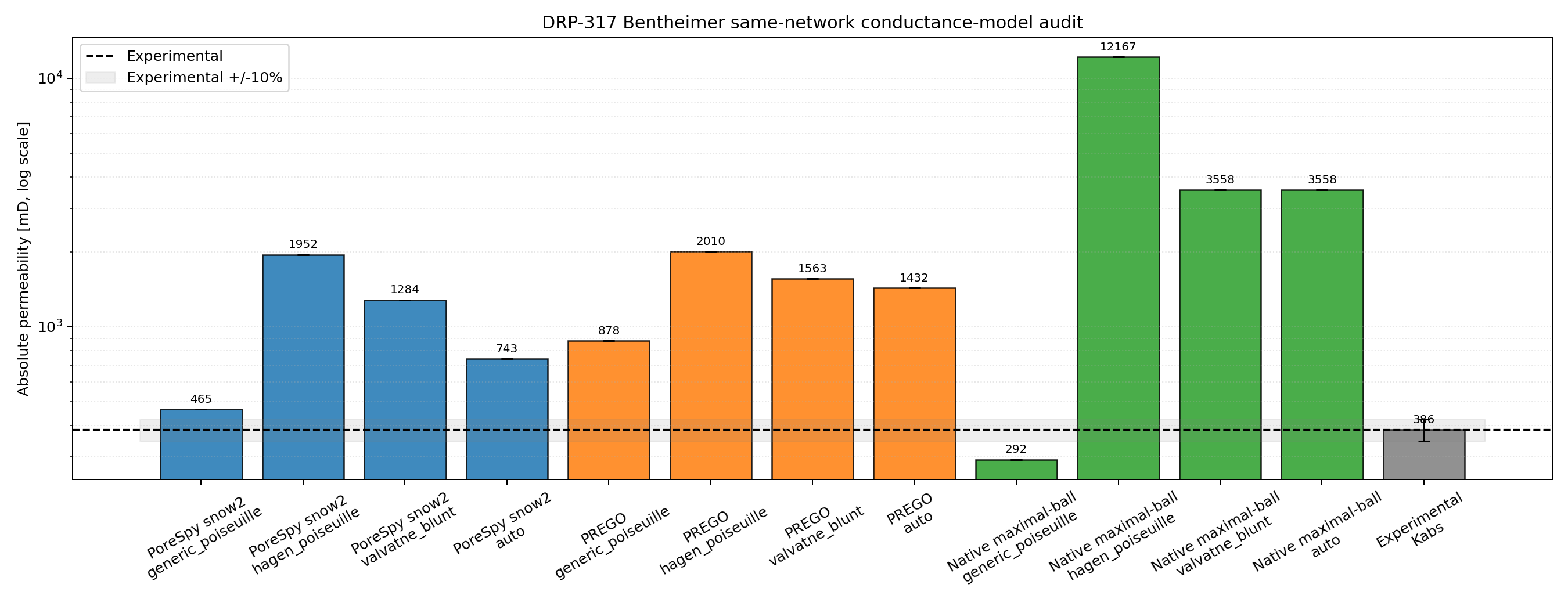
| PoreSpy snow2 | 465.11 | 1951.71 | 1283.64 | 743.38 |
| PREGO | 877.84 | 2009.74 | 1562.90 | 1431.73 |
| Native maximal-ball | 292.38 | 12167.39 | 3558.18 | 3558.18 |
Interpretation
For Bentheimer, the closest aggregate permeability in this rerun is
from Native maximal-ball with a relative permeability error of
-24.25%. The spread between the
largest and smallest primary backend aggregate permeability is about 3.00x,
which makes extraction sensitivity a material part of this sample's validation
result.
The conductance audit is the sharper diagnostic: on the same extracted networks,
hagen_poiseuille, valvatne_blunt, and auto all increase the Bentheimer
permeability relative to the primary generic_poiseuille baseline. For this ROI,
the PREGO overestimate is therefore not fixed by switching to the generated
PoreSpy/OpenPNM-style size factors; the reduced geometry and conduit assumptions
remain the dominant modeling uncertainty.
This is a pore-network comparison against a laboratory-scale experimental reference. The numbers depend on the selected ROI, segmentation convention, boundary labeling, network reduction, and conductance closure; they should not be read as a direct voxel-scale flow simulation.