Solver Backends And Performance
voids exposes sparse linear solver choices in two layers:
- PNM and TPFA use the shared
voids.linalg.solve.solve_linear_systeminterface. - FEM uses DOLFINx assembly and selects a linear algebra path through
FEniCSSolverOptions.linear_backend.
The solver backend is a numerical linear algebra choice. It should not change the pore-network equations, the TPFA discretization, the FEM weak form, the boundary conditions, or the porosity/permeability map closure. If two direct backends disagree beyond roundoff on the same assembled problem, treat that as a numerical diagnostic before interpreting the permeability physically.
Installation
The Pixi default and test environments include the solver feature:
Plain pip install voids keeps optional solver stacks separate. Install Python
solver helpers with:
This extra installs PyAMG but not scikit-umfpack: building the latter from its
PyPI source distribution requires a native SWIG/SuiteSparse toolchain. Use the
binary conda-forge package when selecting the explicit UMFPACK backend.
FEM still requires a compatible DOLFINx/FEniCSx installation. The repository's
Pixi package definition records DOLFINx and binary UMFPACK as conda runtime
dependencies, which allows a published conda voids artifact to supply them
transitively. On native Windows,
the conda-forge DOLFINx stack used by voids does not provide the PETSc-backed
dolfinx.fem.petsc path, so FEM linear_backend="auto" falls back to the
serial SciPy/SuperLU sparse direct backend when PETSc is unavailable.
PNM And TPFA Backends
PNM and TPFA call solve_linear_system(A, b, method=...) after assembling their
sparse systems.
| Method | Backend | Typical use | Main caveat |
|---|---|---|---|
"direct" |
scipy.sparse.linalg.spsolve |
default sparse direct solve | with dtype="float32", voids disables SciPy's optional UMFPACK dispatch so the solve can stay single precision |
"superlu" |
scipy.sparse.linalg.splu |
explicit portable CPU direct solve; useful for comparing float64 and float32 |
serial sparse factorization |
"umfpack" |
scikits.umfpack.spsolve |
explicit SuiteSparse/UMFPACK direct solve, including Windows fallback studies | requires scikit-umfpack and UMFPACK libraries; currently double precision only through the Python wrapper |
"pardiso" |
pypardiso.spsolve |
Linux MKL/PARDISO direct solve | not a portable Windows fallback; currently double precision only through pypardiso |
"nvmath_cudss" |
CSR matrix copied to CUDA tensors and solved with nvmath.bindings.cudss |
experimental GPU direct path for CUDA workstations | requires PyTorch with CUDA and nvmath/cuDSS at runtime; optional single-node multi-GPU cuDSS handle |
"cg" |
SciPy conjugate gradient | symmetric positive systems | convergence depends on conditioning and tolerances |
"gmres" |
SciPy GMRES | nonsymmetric or harder systems | restart and tolerance choices matter |
Backends that support runtime value precision selection accept
solver_parameters={"dtype": "float64"} or
solver_parameters={"dtype": "float32"}. For portable CPU direct
single-precision tests, prefer the explicit "superlu" method:
from voids.physics.singlephase import SinglePhaseOptions
from voids.fvm.singlephase import solve_tpfa

network_options = SinglePhaseOptions(
    solver="superlu",
    solver_parameters={"dtype": "float32"},
)
tpfa_result = solve_tpfa(
    permeability_map,
    solver_method="superlu",
    solver_parameters={"dtype": "float32"},
)
cg and gmres also accept optional PyAMG preconditioning:
from voids.physics.singlephase import SinglePhaseOptions

options = SinglePhaseOptions(
    solver="gmres",
    solver_parameters={
        "rtol": 1.0e-10,
        "maxiter": 800,
        "restart": 80,
        "preconditioner": "pyamg",
    },
)
Explicit UMFPACK for PNM:
from voids.physics.singlephase import SinglePhaseOptions

options = SinglePhaseOptions(solver="umfpack")
Explicit UMFPACK for TPFA:
from voids.fvm.singlephase import solve_tpfa

result = solve_tpfa(permeability_map, solver_method="umfpack")
Experimental cuDSS for PNM or TPFA:
from voids.physics.singlephase import SinglePhaseOptions
from voids.fvm.singlephase import solve_tpfa

network_options = SinglePhaseOptions(
    solver="nvmath_cudss",
    solver_parameters={"device_ids": 0, "dtype": "float64"},
)
tpfa_result = solve_tpfa(
    permeability_map,
    solver_method="nvmath_cudss",
    solver_parameters={"device_ids": 0, "dtype": "float64"},
)
On a workstation with multiple compatible CUDA devices, pass a sequence or
"all" to request a cuDSS multi-GPU handle:
FEM Backends
FEM backends use the same DOLFINx/UFL forms and coefficient maps, then select the linear solve path:
linear_backend |
Linear algebra path | Platform role | Main caveat |
|---|---|---|---|
"auto" |
PETSc when available; SciPy/SuperLU fallback on native Windows when PETSc is missing | recommended default for portable scripts | resolved backend can differ by platform |
"petsc" |
DOLFINx PETSc LinearProblem with PETSc options from FEniCSSolverOptions |
production Linux/macOS path; supports PETSc/MPI workflows | unavailable in native Windows conda-forge DOLFINx stack used by voids; precision follows the installed PETSc/DOLFINx scalar type |
"superlu" |
DOLFINx assembly converted to SciPy CSC format and solved with SciPy's SuperLU wrapper | preferred explicit serial SuperLU backend; supports linear_system_dtype="float64" and "float32" |
serial-only |
"scipy" |
Backward-compatible alias for the SciPy/SuperLU path | serial direct fallback and comparison backend; supports linear_system_dtype="float64" and "float32" |
serial-only |
"umfpack" |
DOLFINx assembly converted to SciPy CSC format and solved with the 64-bit-index scikits.umfpack.UmfpackContext("dl") path |
explicit serial SuiteSparse/UMFPACK path | requires scikit-umfpack; serial-only; currently double precision only |
"pardiso" |
DOLFINx assembly converted to SciPy CSR format and solved with pypardiso.spsolve |
Linux MKL/PARDISO direct path | Linux-only optional dependency; serial-only; currently double precision only |
"nvmath_cudss" |
DOLFINx assembly converted to SciPy CSR format, copied to CUDA tensors, and solved with nvmath.bindings.cudss |
experimental GPU direct path for CUDA workstations | requires PyTorch with CUDA and nvmath/cuDSS at runtime; serial assembly; not a portable default |
Default portable behavior:
from voids.fem.singlephase import FEniCSSolverOptions, upscale_permeability_fem

result = upscale_permeability_fem(problem, options=FEniCSSolverOptions())
print(result.results["x"].metadata["linear_backend"])
Force PETSc, SuperLU, SciPy/SuperLU alias, or UMFPACK:
from voids.fem.singlephase import FEniCSSolverOptions

petsc_options = FEniCSSolverOptions.direct_lu("mumps")
superlu_options = FEniCSSolverOptions.superlu_direct()
superlu_float32_options = FEniCSSolverOptions.superlu_direct(
    linear_system_dtype="float32"
)
scipy_alias_options = FEniCSSolverOptions.scipy_direct()
umfpack_options = FEniCSSolverOptions.umfpack_direct()
On CUDA workstations with a compatible nvmath/cuDSS runtime, the same optional
"nvmath_cudss" backend can be requested explicitly for FEM:
The voids default controls for this cuDSS backend use dtype="float64",
matching, and five iterative-refinement steps. A fresh cuDSS configuration in
the tested nvmath/cuDSS stack reports IR_N_STEPS = 0; voids sets
ir_steps=5 explicitly unless the caller overrides it. The backend also checks
the assembled-system relative residual before accepting the solution. Pass one
device_ids value to
select a CUDA device, pass a sequence such as (0, 1) to request a single-node
multi-GPU cuDSS handle, or pass "all" to use all CUDA devices visible to
PyTorch. The path still performs serial DOLFINx assembly, builds one SciPy CSR
system on the host, and copies the input matrix/vector to the first requested
CUDA device; cuDSS then manages the internal multi-GPU direct factorization.
This backend is intentionally optional and should be compared against a
same-map direct reference before using it for scientific claims.
USFEM Brinkman block solves also have an experimental Schurdiag/cuDSS iterative preset:
from voids.fem.singlephase import FEniCSSolverOptions, solve_brinkman_usfem_block

options = FEniCSSolverOptions.usfem_schurdiag_cudss_experimental(
    dtype="float64",
    device_ids=(0, 1),
)
result = solve_brinkman_usfem_block(problem, options=options)
This preset is specific to solve_brinkman_usfem_block. It uses PETSc/DOLFINx
to assemble the velocity/pressure block forms in one Python process, then solves
the monolithic system with SciPy GMRES and a lower-Schur preconditioner. The
velocity block uses PyAMG by default, and the pressure correction uses
S_hat = A_pp - A_pu diag(A_uu)^-1 A_up, factored once with cuDSS and reused
for every GMRES pressure correction. Use velocity_solver="exact" if you want
a SciPy SuperLU velocity-block solve instead of PyAMG on small comparison
cases. The preset records GMRES residuals, Schurdiag sizes, cuDSS factor times,
device ids, and cuDSS memory estimates in result metadata.
The Schurdiag/cuDSS preset is not a replacement for direct references. It is a
single-process GPU-assisted iterative path for medium and large USFEM maps where
the pressure Schur approximation is much cheaper to factor with cuDSS than with
CPU direct solvers. Start with dtype="float64"; local high-contrast probes
showed good permeability and field agreement in double precision, while
single-precision Schurdiag preconditioning could produce small final GMRES
residuals but poor pressure-field agreement.
For pressure factors that do not fit in device memory, cuDSS hybrid memory mode can be requested:
large_options = FEniCSSolverOptions.usfem_schurdiag_cudss_experimental(
    dtype="float64",
    device_ids=(0, 1),
    hybrid_mode=True,
    hybrid_device_memory_limit=20_000_000_000,
)
Hybrid memory should be treated as a capacity fallback, not a speed setting. On
the local two-A5000 workstation, a 300^3 synthetic image reduced to a 30^3 map
exceeded non-hybrid cuDSS device memory during the Schurdiag pressure
factorization; enabling hybrid memory avoided that immediate allocation failure
and entered GMRES, but the run was still too slow for a default benchmark row.
For monolithic USFEM direct solves, the same workstation solved 10^3, 20^3, and
30^3 maps in float64, but a 500^3 synthetic image reduced to a 50^3 map did
not produce an accepted direct cuDSS result: non-hybrid float64 exceeded
device-memory estimates, hybrid float64 failed in the installed multi-GPU
cuDSS path, and hybrid float32 either failed the residual check or returned
non-finite permeability/flow values.
NVIDIA documents two separate hybrid concepts: hybrid memory mode stores part
of cuDSS internal factor data in host memory while GPU kernels still perform
factorization/solve, whereas hybrid execute mode can place some computation on
the host. Do not enable both together. NVIDIA also documents
CUDSS_CONFIG_USE_CUDA_REGISTER_MEMORY as an option that controls
cudaHostRegister() use for hybrid-memory transfers; it does not by itself
enable host-memory factor storage, and the tested cuDSS runtime already enables
it by default. host_nthreads affects cuDSS only when a cuDSS threading-layer
library is loaded. voids can load the packaged libcudss_mtlayer_gomp
library automatically when host threading is requested, and callers can pass
threading_lib=... to override discovery; however, the tested nvmath/cuDSS
multi-GPU handle rejected host-threaded runs with CUDSS_STATUS_INVALID_VALUE,
so voids blocks host_nthreads/threading_lib for multi-GPU cuDSS solves in
that runtime.
See the NVIDIA cuDSS
hybrid memory documentation,
configuration parameter documentation,
and nvmath-python
DirectSolverOptions
for the corresponding upstream controls.
cuDSS exposes several numerical controls that can be useful for single
precision experiments on ill-conditioned maps. voids forwards
ir_steps, use_matching, matching_alg, pivot_type,
pivot_threshold, pivot_epsilon, pivot_epsilon_alg, reordering_alg,
factorization_alg, solve_alg, nd_nlevels, host_nthreads,
threading_lib, hybrid_mode, hybrid_device_memory_limit,
hybrid_execute_mode, use_cuda_register_memory, use_superpanels, and
deterministic_mode when the installed cuDSS runtime supports them. For
example, a more conservative single-precision USFEM trial can increase
iterative refinement and perturb very small pivots, but this should be treated
as a diagnostic run rather than an accepted accuracy setting:
cudss_float32_usfem_trial = FEniCSSolverOptions.nvmath_cudss_direct(
    dtype="float32",
    device_ids=0,
    ir_steps=20,
    pivot_epsilon=1.0e-4,
)
This is still a trial configuration, not a portable default. On a 300^3
synthetic image block-averaged to a 30^3 map with porosity floor 1.0e-3,
permeability floor 1.0e-20, and permeability cap 1.0e-8, this
kind of single-precision setting can reduce memory but must be judged by
same-map field errors, not just by the final linear residual or permeability.
The same caution applies to TPFA at high contrast; use float64 or a separately
validated scaled formulation unless a same-map reference confirms the lower
precision result. Some cuDSS controls are version/backend dependent: in the
tested nvmath/cuDSS stack, explicit reordering_alg values ALG_1/ALG_2 and
deterministic_mode=True raised cuDSS NOT_SUPPORTED.
For USFEM mixed Brinkman systems, the serial SciPy/SuperLU path can sometimes reduce fill by disabling diagonal pivoting after the standard COLAMD preordering:
Accept this only after comparison against an untuned direct reference on the same coefficient map. This remains a serial SuperLU factorization; it is a portable reference/medium-size backend, not a replacement for PETSc SuperLU_DIST on large USFEM maps.
For reproducible reports, store the requested backend, the resolved backend from
result metadata, the formulation name, pressure drop, map shape, permeability
and porosity floors, serial_sparse_linear_system_dtype when present, and the
numerical thread environment.
Taylor-Hood Brinkman and USFEM Brinkman also accept nondimensional=True, or a
BrinkmanNondimensionalization object, to assemble a coefficient-scaled
equivalent system. The default uses the viscous scale
\(U=\Delta P L/\mu\); constant-permeability maps can also use
velocity_scale="unit_darcy" for \(U=\Delta P K/(\mu L)\). The returned
velocity, pressure, flow rate, and permeability remain in physical units; the
scale choices are recorded in result metadata. Use this as a conditioning and
solver-experiment control, and still compare any iterative result against a
direct reference on the same map.
Benchmark Design
The executable benchmark is
17_mwe_solver_options_benchmark.
It writes stable plots and CSV tables under docs/assets/solver_backends/.
The GPU-focused notebook source
notebooks/47_mwe_gpu_solver_backend_comparison.py compares the optional
"nvmath_cudss" backend against CPU direct references for PNM, TPFA, and the
serial FEM formulations. It is not rendered into the public docs because the
CUDA runtime is optional and machine-specific.
The PNM section compares:
- SciPy direct solve,
- explicit UMFPACK direct solve,
- CG and GMRES,
- CG/GMRES with PyAMG preconditioning,
- Picard and Newton outer iterations for pressure-dependent viscosity.
The FEM section compares PETSc/MUMPS, SciPy direct sparse, and UMFPACK on homogeneous 2-D maps for:
- Taylor-Hood Darcy-Darcy,
- Taylor-Hood Darcy-Brinkman,
- stabilized USFEM Darcy-Brinkman.
It reports permeability, flow rate, pressure field relative \(L^2\) difference, velocity field relative \(L^2\) difference, and repeated-run wall time.
Benchmark Results
The current benchmark data are available as CSV artifacts:
- PNM constant-viscosity solver table
- PNM variable-viscosity solver table
- Solver speedup table
- FEM backend benchmark table
- FEM backend summary table
The headline results from the generated tables are:
| Benchmark slice | Best local median runtime | Agreement with reference |
|---|---|---|
| PNM constant-viscosity network solve | CG, 0.0093 s | \(K\) relative difference \(3.8 \times 10^{-14}\) |
| PNM constant-viscosity direct solve | UMFPACK, 0.0101 s | \(K\) relative difference \(3.7 \times 10^{-15}\) |
| PNM variable-viscosity Newton solve | SciPy direct, 0.0180 s | reference row |
| FEM backend summary | UMFPACK, 0.0099 s median over 9 cases | max field relative \(L^2\) difference \(2.5 \times 10^{-15}\) |
| FEM backend summary | SciPy direct, 0.0104 s median over 9 cases | max field relative \(L^2\) difference \(2.6 \times 10^{-15}\) |
| FEM backend summary | PETSc/MUMPS, 0.0211 s median over 9 cases | reference row |
These numbers are from the local serial notebook run used to generate the committed assets. They are performance evidence for this benchmark size and machine, not a universal backend ranking.
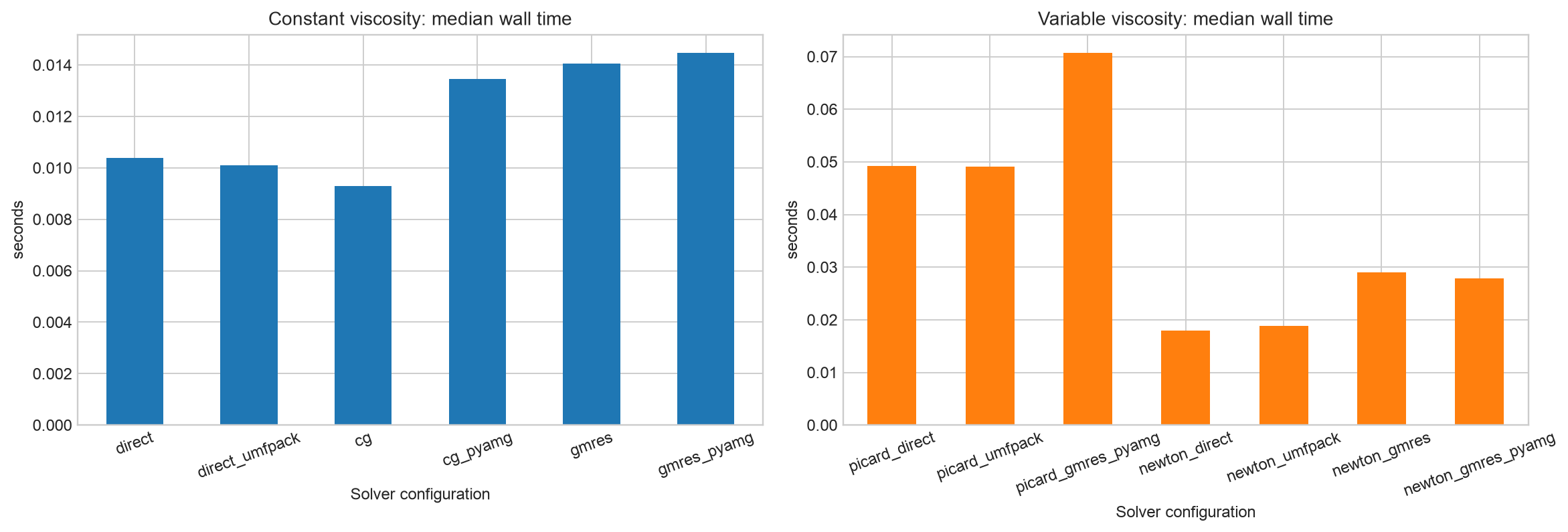
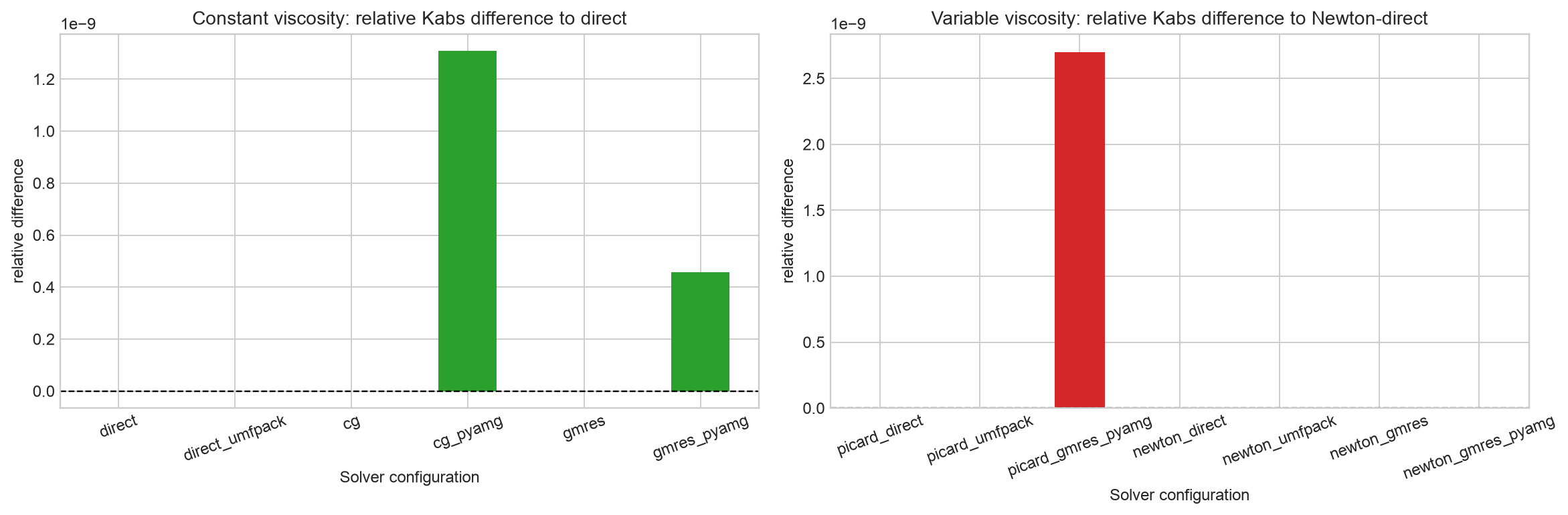
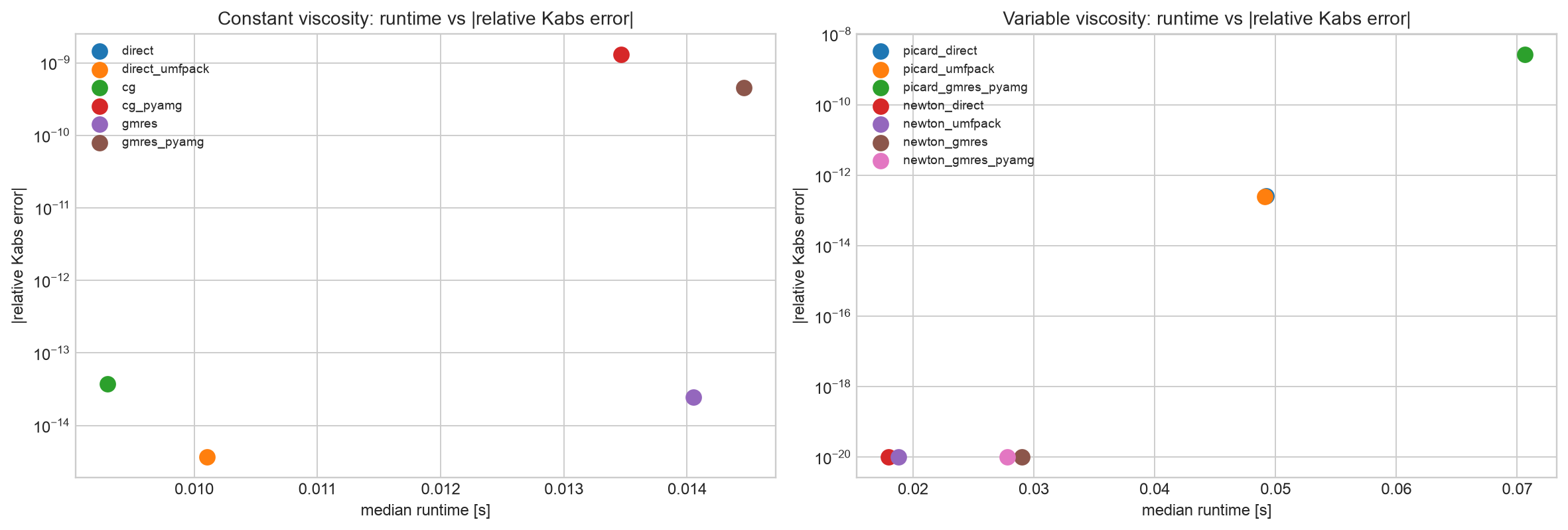
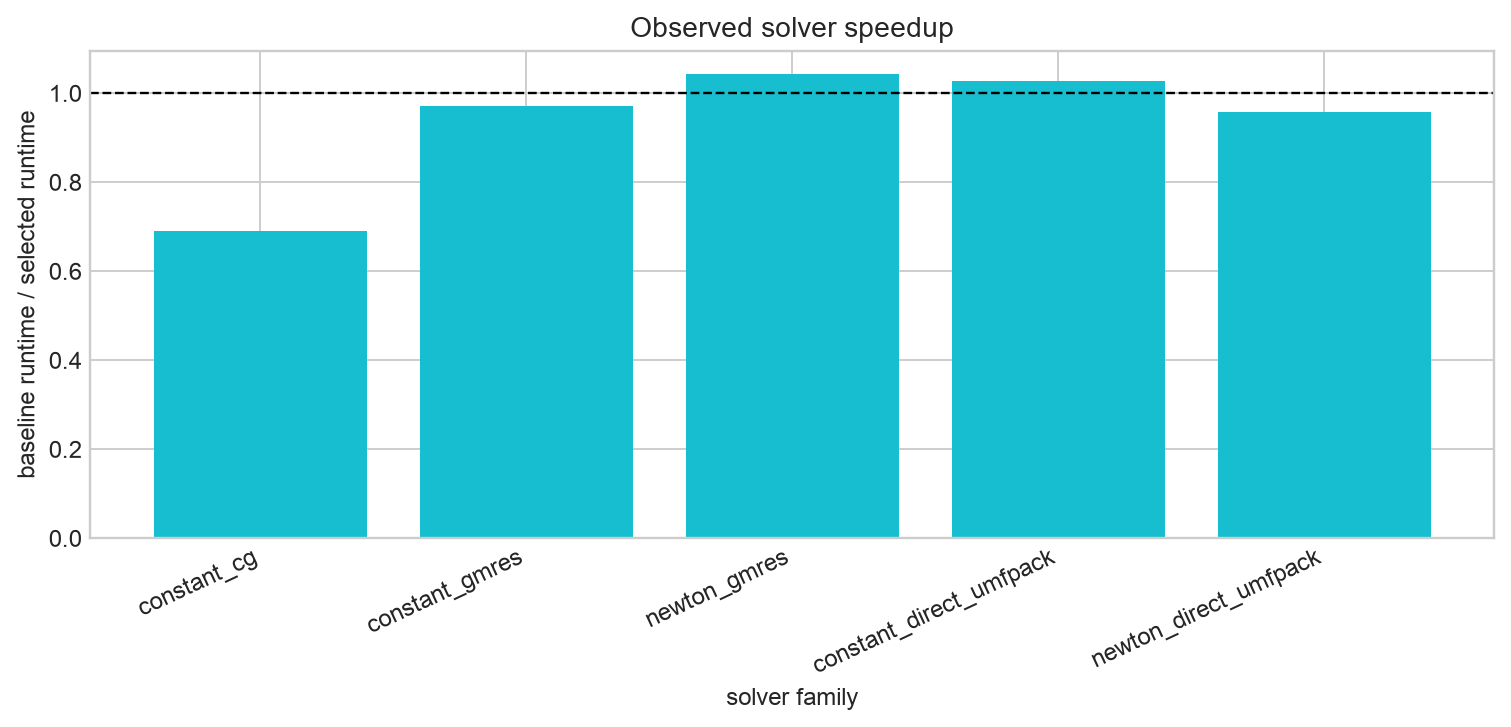
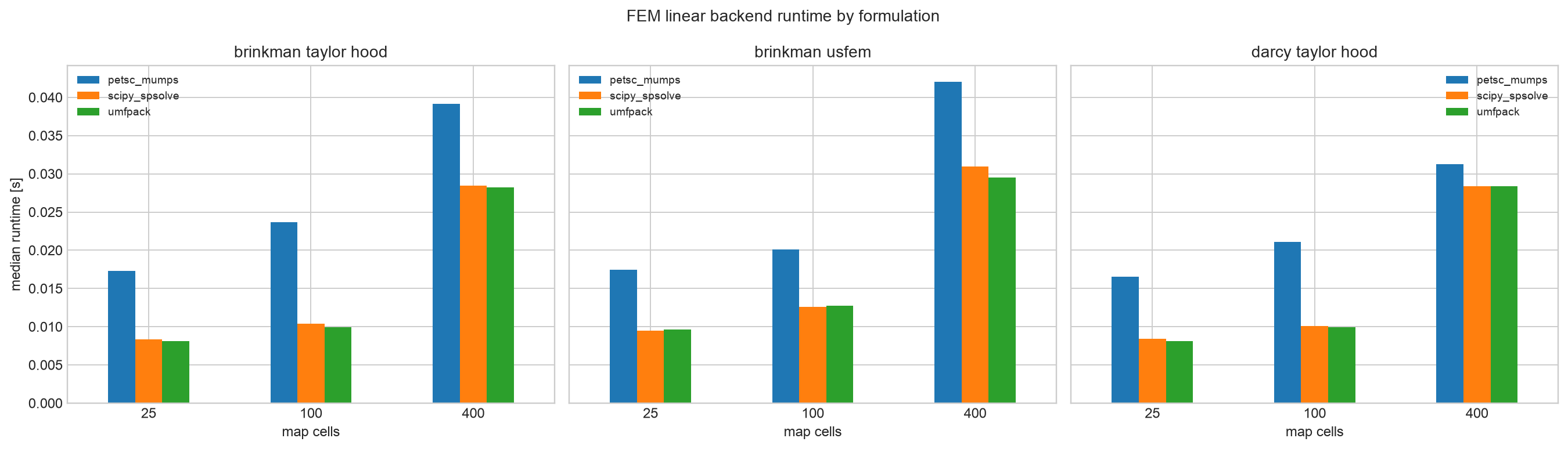
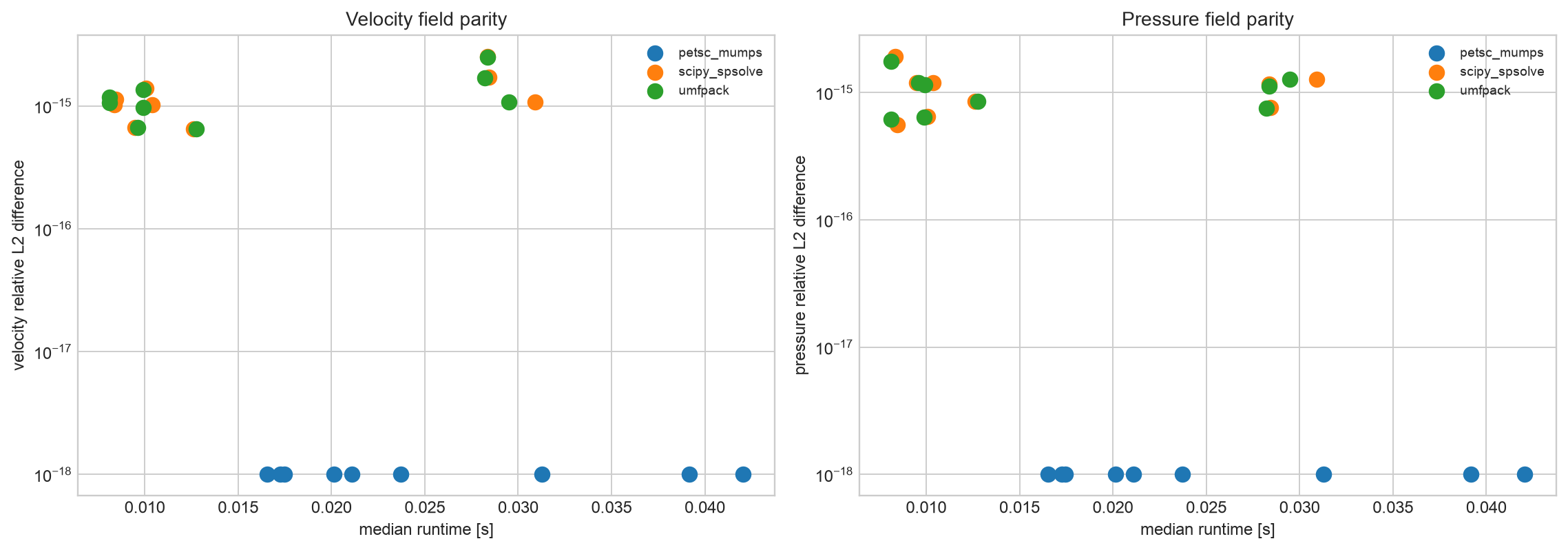
On the homogeneous benchmark systems, the direct sparse backends recover the same PNM permeability and flow rate to roundoff. The FEM backends recover the same permeability, flow rate, pressure field, and velocity field to numerical roundoff when all requested backends are installed. Runtime ranking is local to the benchmark machine and problem size; for larger heterogeneous 3-D maps, repeat the notebook at the target resolution before choosing a production backend.
Performance Guidance
- Use
"direct"for the most portable PNM/TPFA baseline. - Use
"umfpack"when you want to request SuiteSparse/UMFPACK explicitly, especially for Windows-compatible direct-solver studies. FEM UMFPACK solves force the 64-bit-index family to avoid misleading 32-bit UMFPACK workspace failures on larger mixed systems. For USFEM-style mixed Brinkman systems, start tuning withFEniCSSolverOptions.umfpack_direct(strategy="unsymmetric"); loweringpivot_tolerancecan be faster but should be accepted only after comparison against a direct reference on the same coefficient map. - Use
"pardiso"only when the Linux MKL/PARDISO stack is available and has been checked against the same system. - Use
"nvmath_cudss"only on CUDA machines with the optional nvmath/cuDSS runtime installed. It is available for PNM, TPFA, and serial FEM direct solves; LBM does not use this sparse direct backend. On multi-GPU workstations, start withdevice_ids=(0, 1)ordevice_ids="all"for large double-precision systems that do not fit comfortably on one GPU. For USFEM Brinkman maps, preferFEniCSSolverOptions.usfem_schurdiag_cudss_experimental(dtype="float64", device_ids=(0, 1))when you want the GPU-assisted iterative Schurdiag path. Keepdtype="float64"unless a same-map direct reference, residual check, and pressure/velocity field comparison justify a lower precision. - Use Krylov methods with PyAMG when direct factorizations become too expensive, but record convergence tolerances and residuals.
- Use FEM
"petsc"for PETSc/MPI or heavily configured production runs. - Use FEM
"superlu"or"umfpack"for serial Windows-compatible FEM solves when DOLFINx core is available but PETSc is not. The older FEM"scipy"name remains accepted as an alias for the SuperLU path. For USFEM, tryFEniCSSolverOptions.superlu_direct(permc_spec="COLAMD", diag_pivot_thresh=0.0)when the default SuperLU pivoting creates excessive fill, and keep the result tied to a same-map reference comparison.
Scientific Caveats
Solver agreement does not prove that the physical closure is correct. Permeability estimates still depend on pore/throat geometry, map construction, permeability floors, porosity floors, pressure conventions, side-wall conditions, and representative-volume assumptions.