DRP-317 LBM Default Sensitivity
This validation note records the setup study used to choose the default
XLBOptions.steady_stokes_defaults() preset for direct-image LBM permeability
estimates in voids. The question was narrow: whether the poor LBM agreement
with the DRP-317 Berea and Bentheimer experimental bulk permeabilities could be
explained by an obviously weak numerical setup.
The answer is no. The stricter setup improves numerical hygiene and is now the recommended default, but it changes the DRP-317 same-ROI permeability estimates by only about 1-6 %. The remaining mismatch with experiment is therefore not removed by LBM tolerance, driving, or reservoir-length tuning alone.
Recommended Default
The recommended steady Stokes-limit preset is:
| Option | Value |
|---|---|
formulation |
steady_stokes_limit |
lattice_viscosity |
0.10 |
pressure_drop_lattice |
6.667e-5 |
inlet_outlet_buffer_cells |
12 |
max_steps |
8000 |
min_steps |
1200 |
check_interval |
100 |
steady_rtol |
1.0e-4 |
The preset still uses XLB's incompressible Navier-Stokes LBM stepper. The
steady_stokes_limit label means that voids uses small lattice pressure
driving, reservoir buffers, and steady-state diagnostics so the result can be
interpreted as a low-Mach, low-Reynolds creeping-flow estimate.
For the meaning of each LBM option and a reusable tuning workflow for new samples, see the LBM section of Map-Based Single-Phase Solvers.
Sensitivity Design
Two representative axes were selected from the same \(75^3\) ROIs used in the same-ROI map-solver validation pages:
| Sample | Axis | ROI origin [voxels] | ROI porosity |
|---|---|---|---|
| Berea | \(x\) | (694, 462, 462) |
21.666 % |
| Bentheimer | \(y\) | (0, 694, 694) |
26.624 % |
The sweep varied four numerical choices:
- steady-state tolerance and minimum iteration count,
- inlet/outlet reservoir length,
- pressure-drop magnitude, to test Darcy-linearity of the response,
- BGK lattice viscosity, to expose relaxation-time and wall-location sensitivity.
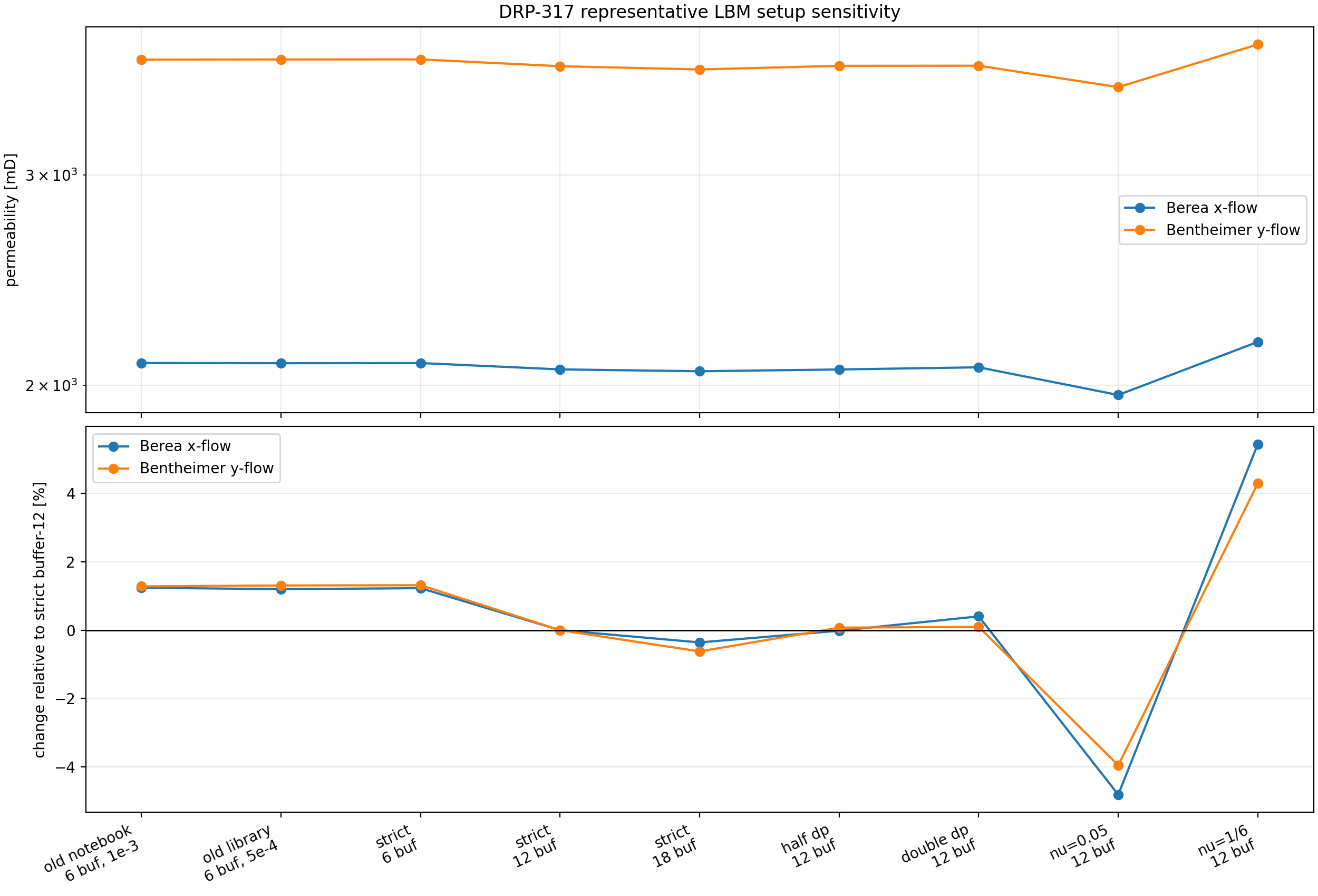
The table reports permeability and percent change relative to the selected recommended preset:
| Configuration | Berea \(x\) [mD] | Change | Bentheimer \(y\) [mD] | Change |
|---|---|---|---|---|
| previous notebook preset | 2087.9 | +1.24 % | 3748.2 | +1.28 % |
| previous library preset | 2087.1 | +1.20 % | 3749.1 | +1.31 % |
| strict, buffer 6 | 2087.7 | +1.23 % | 3749.4 | +1.32 % |
| recommended strict, buffer 12 | 2062.3 | +0.00 % | 3700.7 | +0.00 % |
| strict, buffer 18 | 2055.0 | -0.36 % | 3677.7 | -0.62 % |
| recommended with half pressure drop | 2062.0 | -0.02 % | 3703.4 | +0.07 % |
| recommended with double pressure drop | 2070.7 | +0.40 % | 3704.3 | +0.10 % |
recommended with nu_lu=0.05 |
1963.1 | -4.81 % | 3554.3 | -3.95 % |
recommended with nu_lu=1/6 |
2174.6 | +5.44 % | 3859.6 | +4.29 % |
Interpretation
The pressure-drop tests are the most important physical sanity check. Halving or doubling the lattice pressure drop changes the inferred permeability by less than 0.5 % in these representative runs, while reducing or increasing Mach and voxel-Reynolds diagnostics approximately as expected. That supports the Darcy-linearity of the selected pressure drop.
The buffer-length tests show a small but systematic reservoir effect. Moving from 6 to 12 reservoir cells lowers the permeability by about 1.2-1.3 % in the representative axes; moving from 12 to 18 cells adds less than another 1 %. The 12-cell buffer is therefore a useful compromise between boundary-condition separation and runtime.
The BGK viscosity tests are larger, around 4-5 %. This is a numerical-model sensitivity of the current BGK, bounce-back, voxel-staircase setup. It is not a parameter that should be fitted to experimental permeability. A future TRT/MRT or grid-refinement study would be a better way to reduce or quantify this source of uncertainty.
Full Same-ROI Update
After selecting the strict buffer-12 preset, all six Berea and Bentheimer directions were rerun. The plot below compares the previous validation preset with the recommended preset.
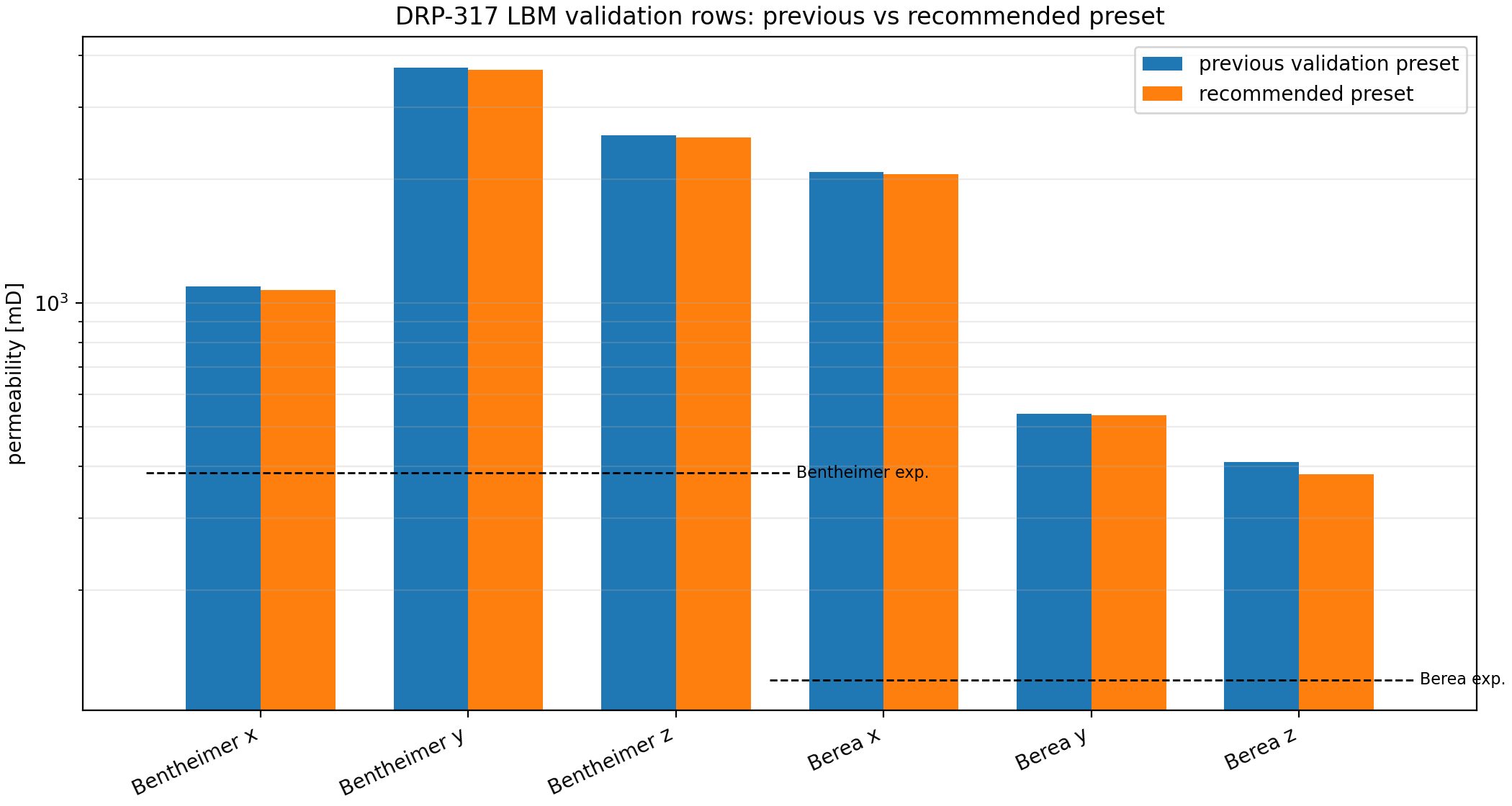
| Sample | Axis | Previous K [mD] | Recommended K [mD] | Change | Steps | Time [s] |
|---|---|---|---|---|---|---|
| Berea | \(x\) | 2087.9 | 2062.3 | -1.23 % | 1400 | 55.2 |
| Berea | \(y\) | 537.1 | 532.2 | -0.92 % | 2800 | 106.7 |
| Berea | \(z\) | 409.9 | 383.8 | -6.37 % | 4000 | 159.9 |
| Bentheimer | \(x\) | 1097.3 | 1076.1 | -1.93 % | 1700 | 68.3 |
| Bentheimer | \(y\) | 3748.2 | 3700.7 | -1.27 % | 1300 | 51.9 |
| Bentheimer | \(z\) | 2556.2 | 2529.2 | -1.06 % | 1800 | 71.0 |
All six recommended runs converged under the stricter criterion. The maximum observed lattice Mach number was \(5.03\times10^{-4}\), and the maximum voxel-scale Reynolds diagnostic was \(2.90\times10^{-3}\), both from the Bentheimer \(x\)-direction run.
Consequence For The Validation Studies
The updated LBM rows remain substantially above the published scalar bulk permeabilities:
- Berea: \(K_x=2062.3\) mD, \(K_y=532.2\) mD, and \(K_z=383.8\) mD versus \(K_\mathrm{exp}=121\) mD.
- Bentheimer: \(K_x=1076.1\) mD, \(K_y=3700.7\) mD, and \(K_z=2529.2\) mD versus \(K_\mathrm{exp}=386\) mD.
Because the direct-image LBM solve does not use the Kozeny-Carman permeability map, this overprediction cannot be attributed to the map cap alone. The most conservative interpretation is that the small \(75^3\) ROIs, segmentation / porosity mismatch, voxel-scale boundary treatment, and sample representativeness remain the controlling uncertainty sources. The default update makes the LBM row more defensible numerically, but it does not calibrate the method to the experiments.