Two-Dimensional Body-Fitted Vug Report
This is a synthetic benchmark with no known exact flow field, not MMS. It tests geometry construction, coefficient partitioning, boundary conditions, field behavior, and flow-based upscaling for a controlled centered vug family.
Physical case family
A \(500^2\)-voxel image with \(15\,\mu\mathrm m\) voxels defines a \(L=7.5\,\mathrm{mm}\) square. The porous matrix has \(\phi_m=0.2\), \(K_m=200\,\mathrm{mD}=1.9738466\,10^{-13}\,\mathrm m^2\), and \(\mu=10^{-3}\,\mathrm{Pa\,s}\). A centered circle represents \(f_v=(0,0.01,0.05,0.1,0.2,0.4,0.6,0.7)\), with
The \(f_v=0\) member is matrix only. The \(f_v=0.7\) circle remains contained; the strict geometric upper limit is \(\pi/4\).
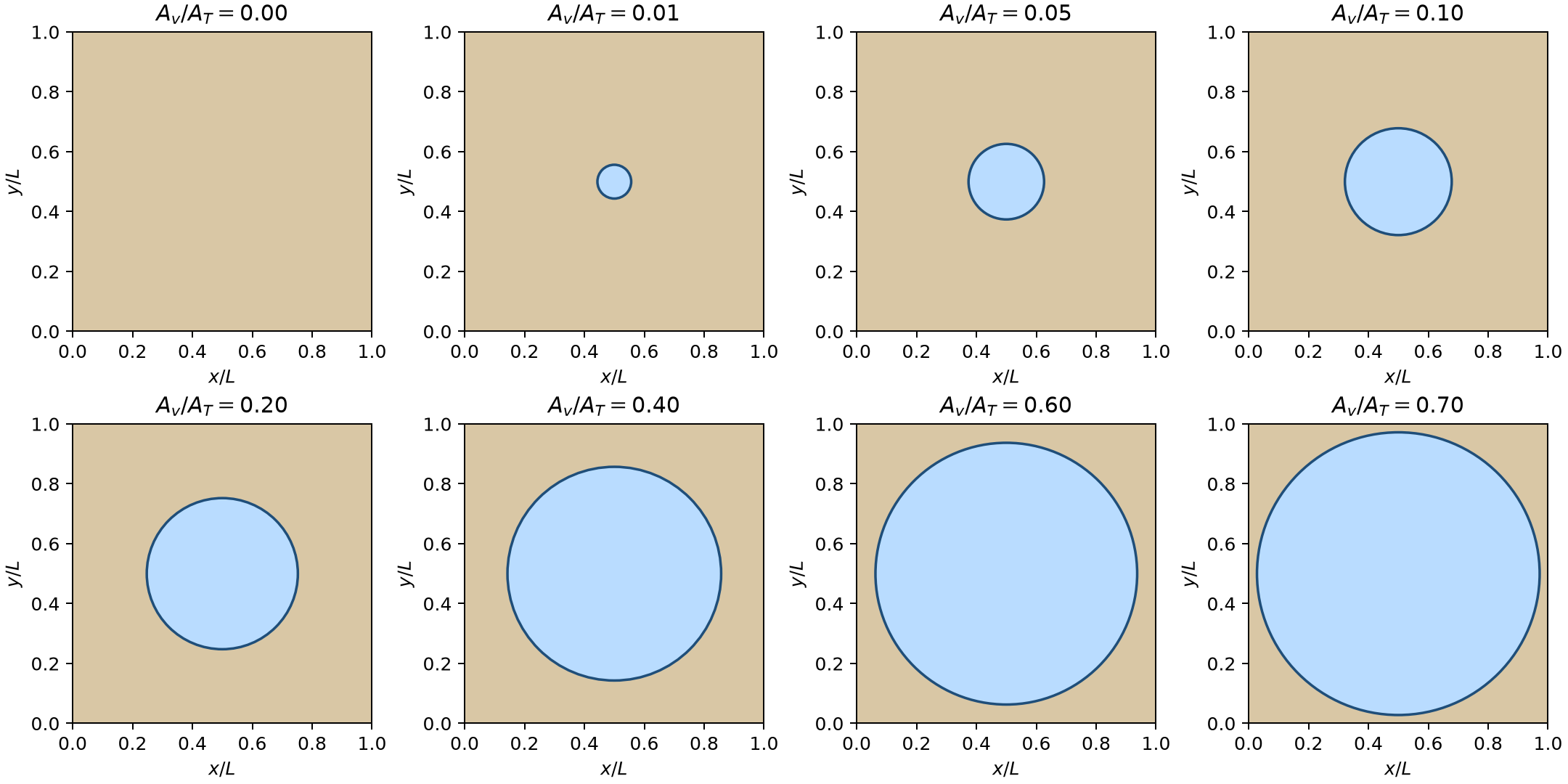
Gmsh fragments the circle and square, preserving matrix, vug, exterior, and interface tags. The nominal resolution is 100, producing about 11,800 nearly uniform triangles per case; there is no intentional interface refinement.
Models, weak forms, and boundary conditions
Let \(V_h=[\mathrm{CG}_2]^2\), \(Q_h=\mathrm{CG}_1\). Both branches use \(p_L=1\,\mathrm{Pa}\), \(p_R=0\), so \(\Delta p=1\,\mathrm{Pa}\). Natural pressure traction is applied on left/right. The top and bottom impose zero normal velocity and natural tangential traction.
For Darcy--Brinkman, find \((\mathbf u_h,p_h)\in V_h\times Q_h\) such that
The vug reaction is exactly zero. No artificial vug permeability is used in this Brinkman branch.
The Darcy--Darcy VMS branch omits diffusion and uses \(\gamma_D=\mu/K_m\) in the matrix and \(\mu/K_v\) in the vug, with configurable \(K_v=10^{-8}\,\mathrm m^2\). Its additional residual term is
\(K_v\) is a numerical free-flow closure for Darcy--Darcy, not a measured intrinsic permeability of an open cavity.
Pressure and velocity fields
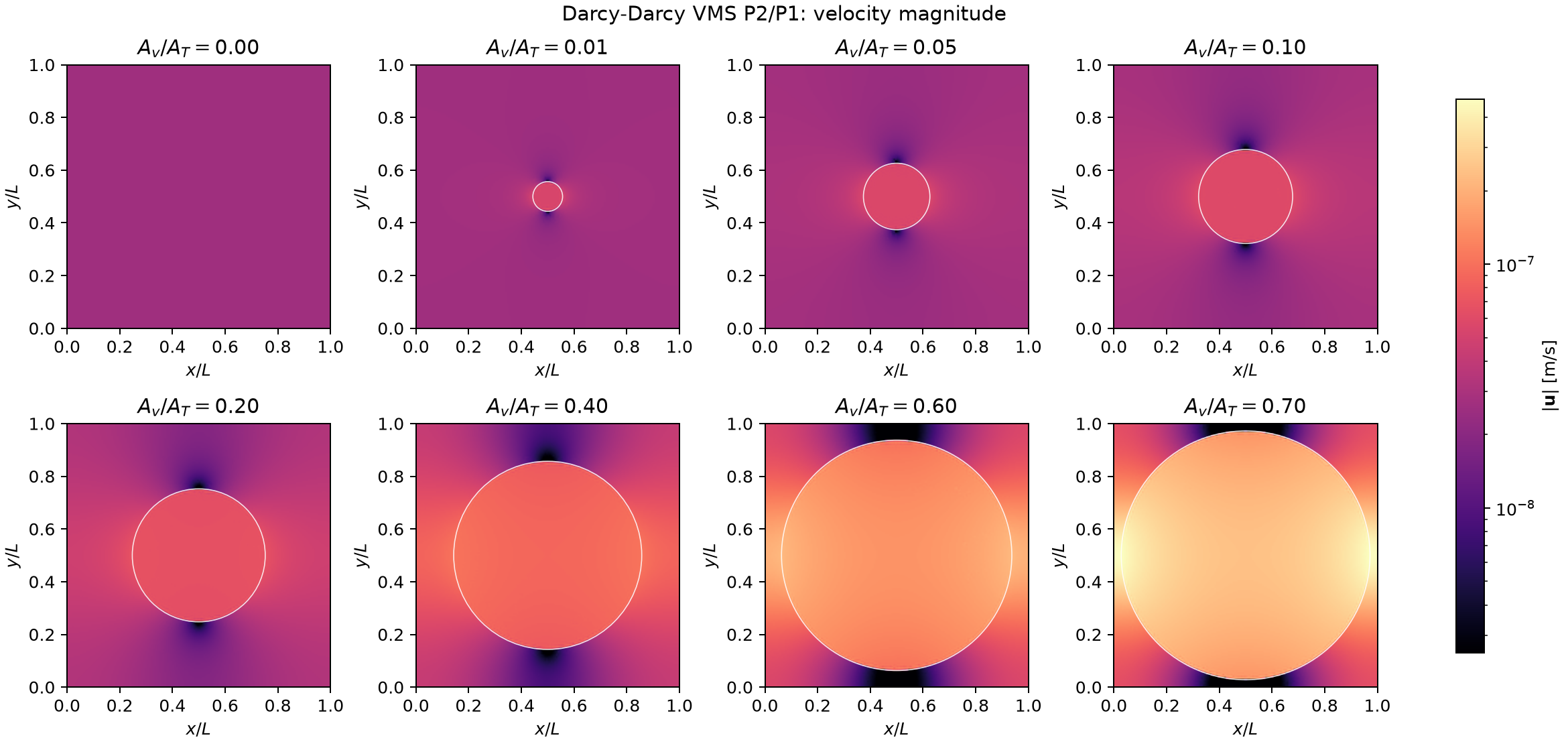
All panels below are completed finite-element solves. The pressure shown is shifted to zero domain mean after solving; pressure differences and fluxes are unchanged.
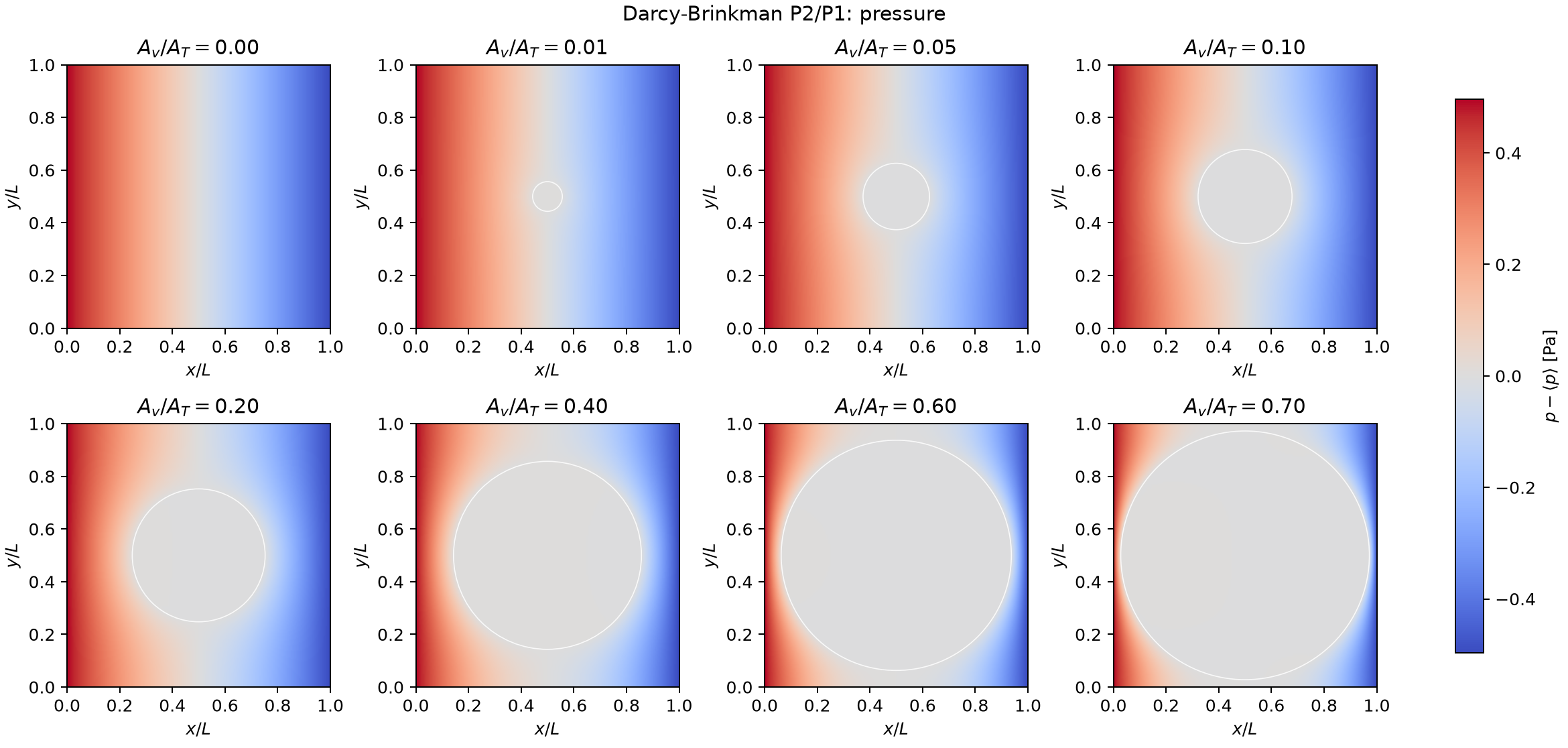
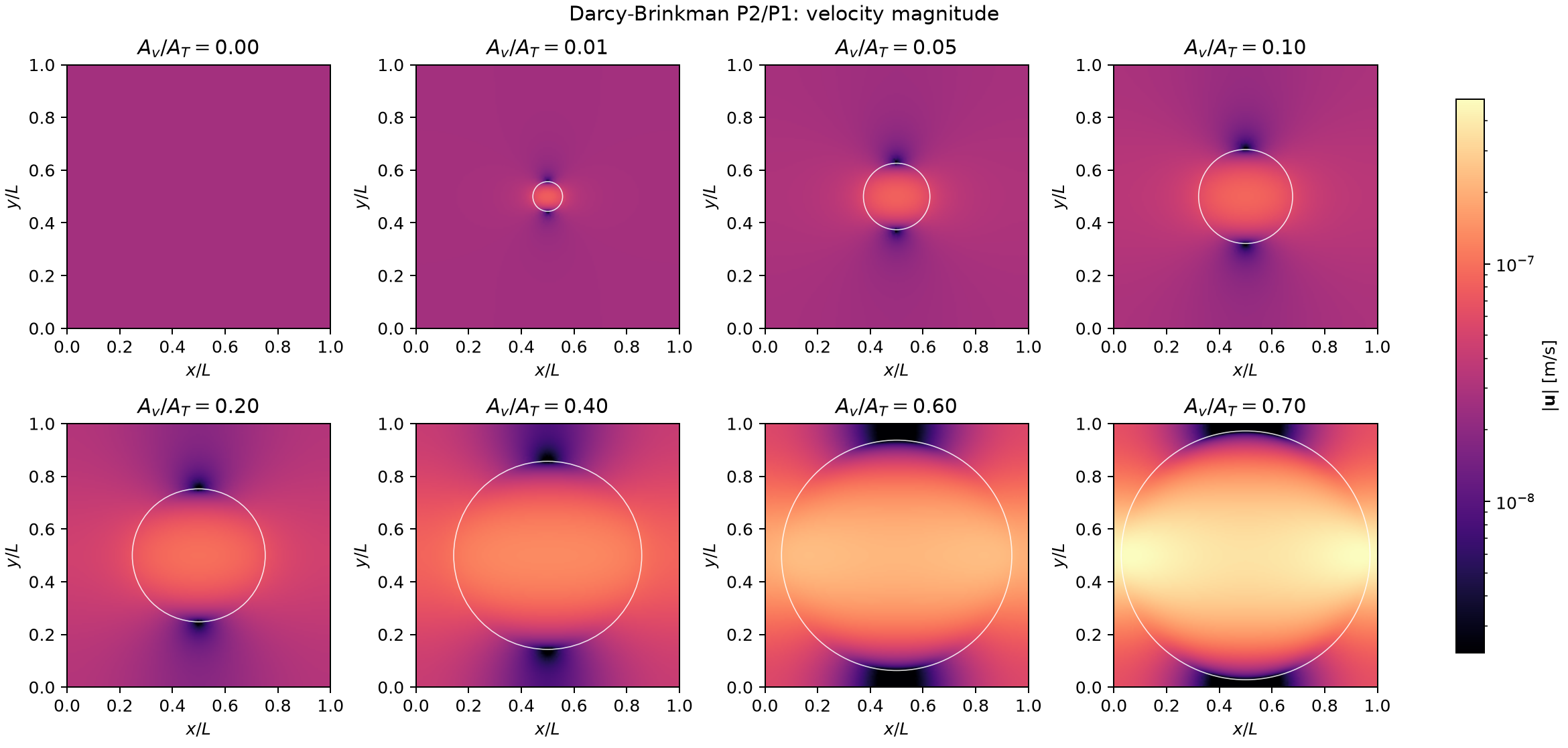
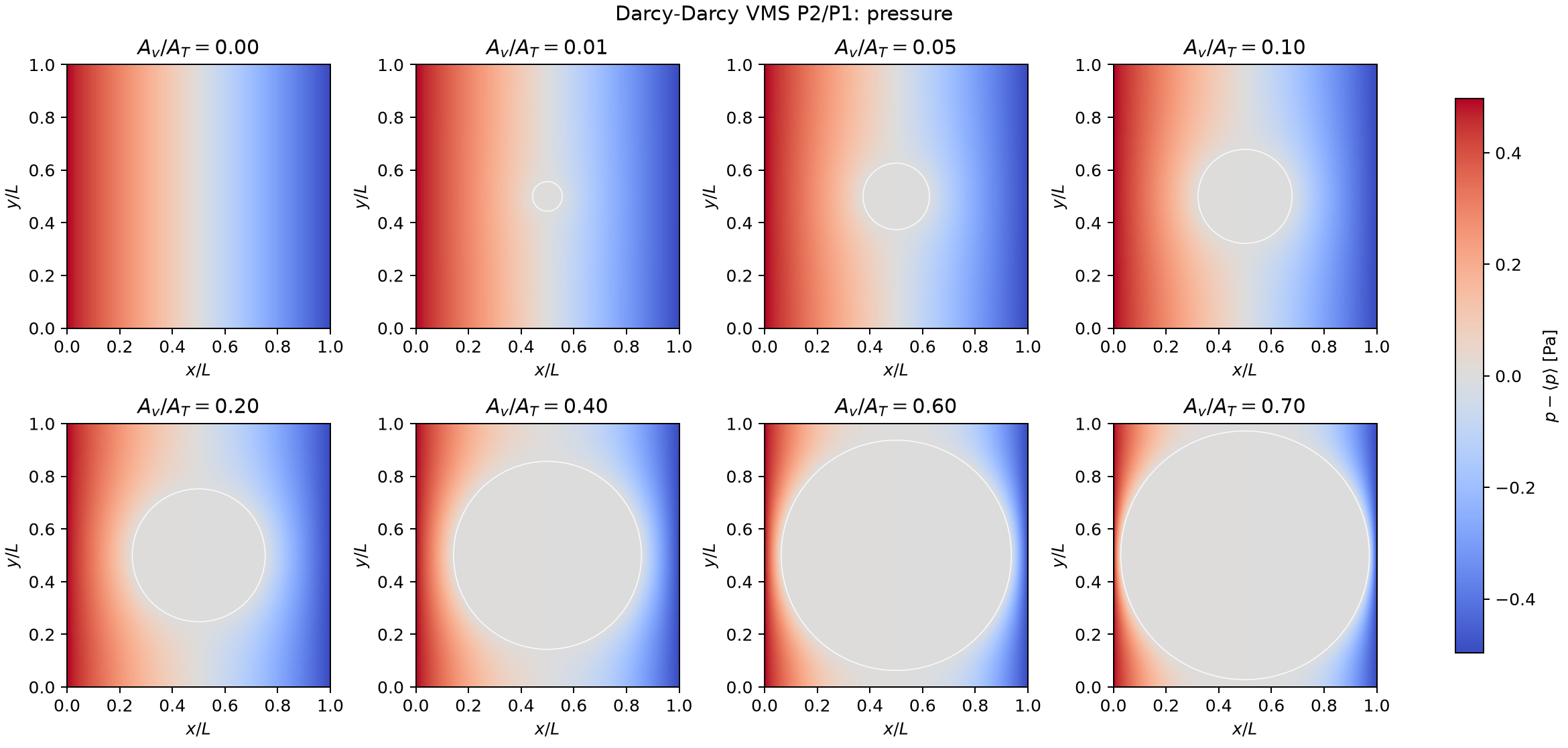
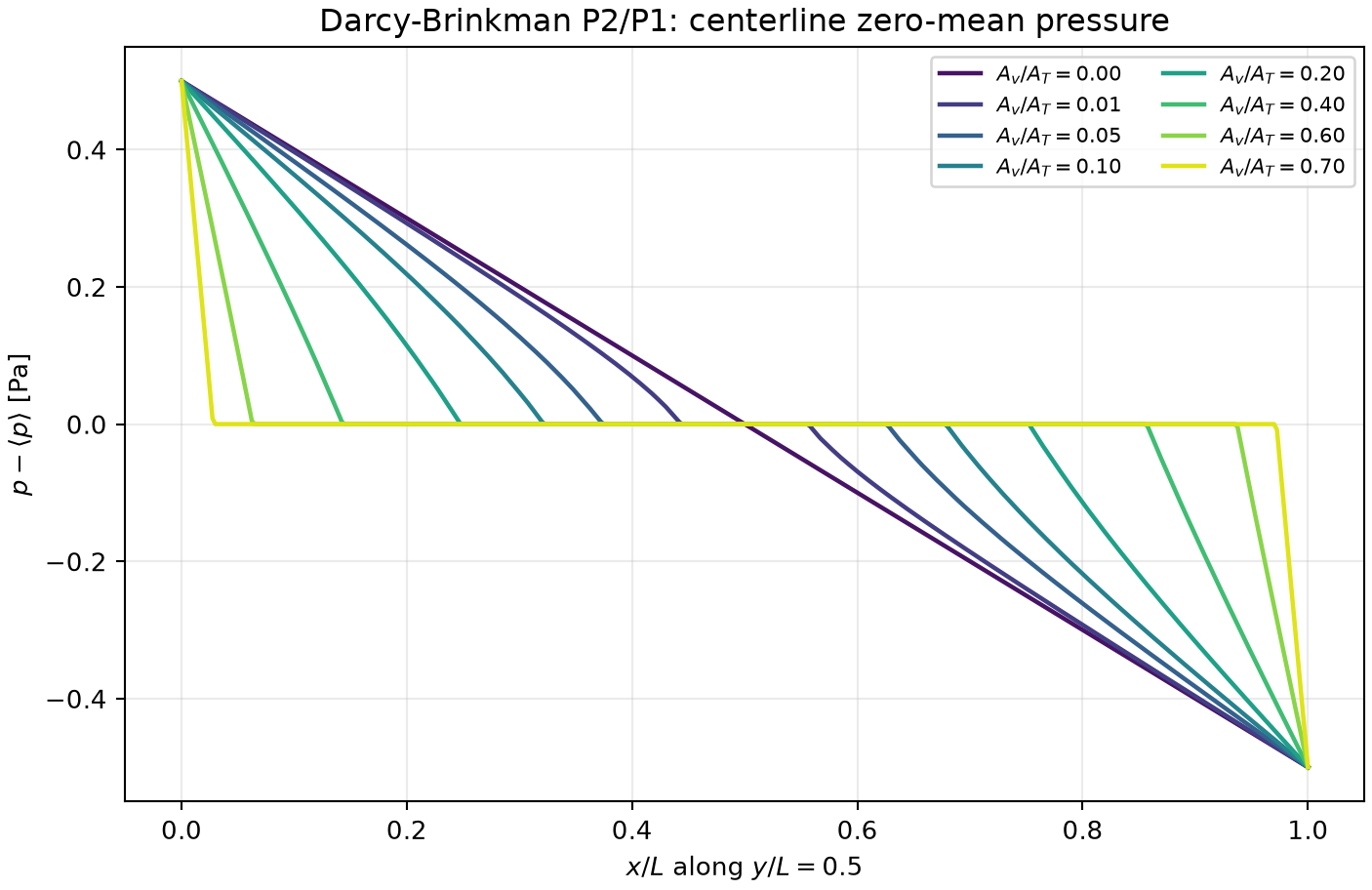
The horizontal midline \(y=L/2\) exposes components that a magnitude plot can hide:
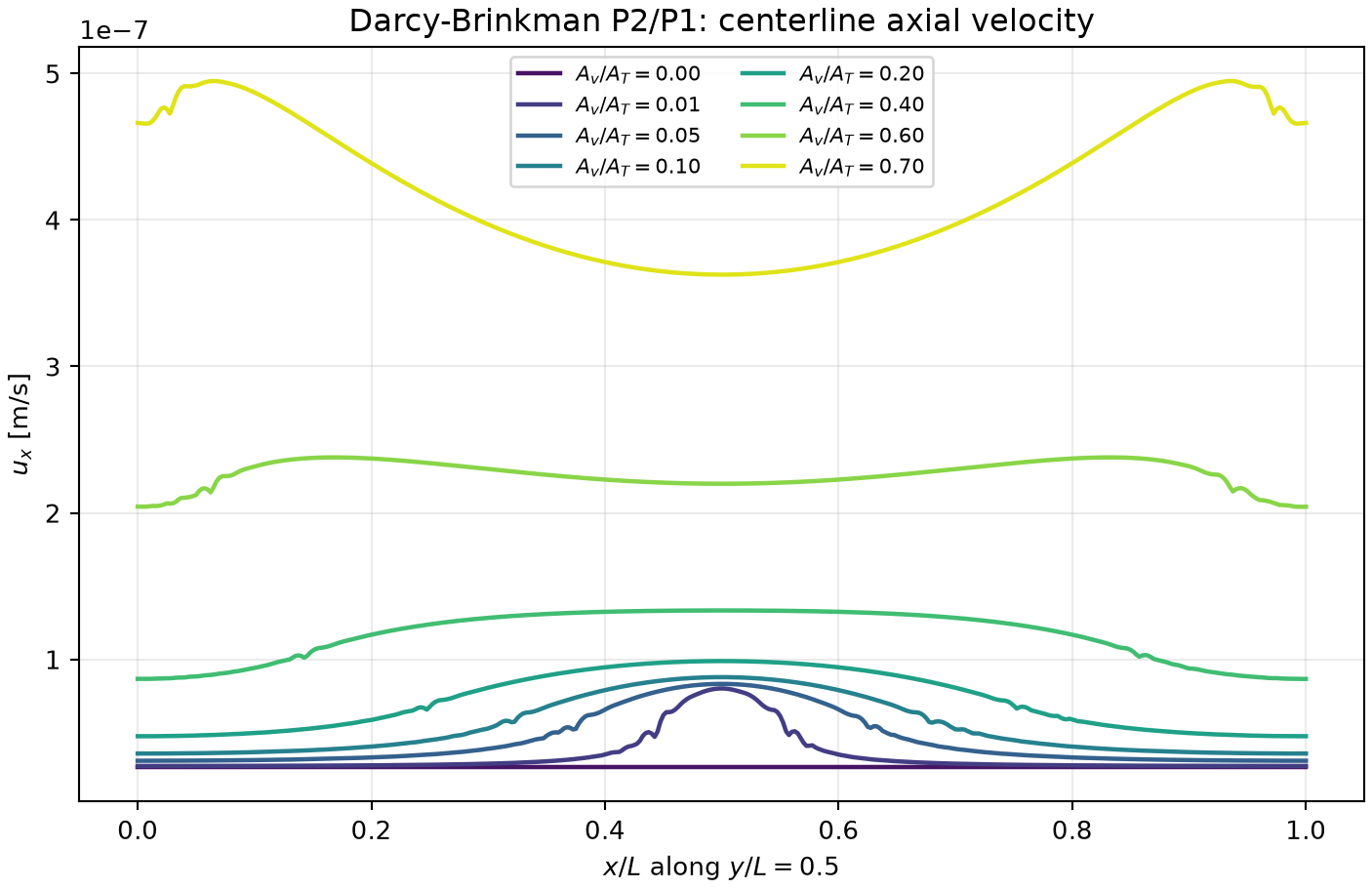
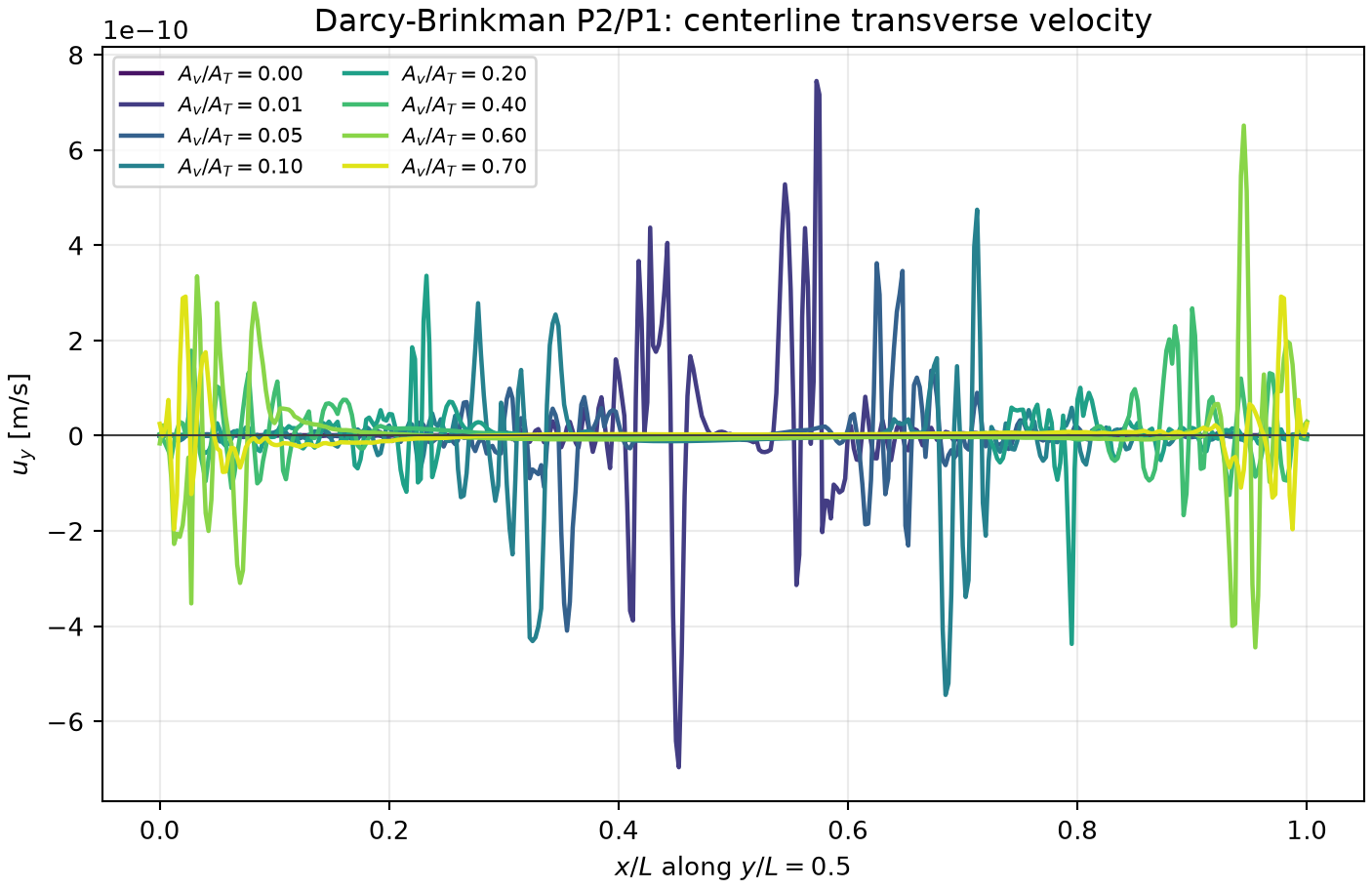
Symmetry predicts \(u_y=0\) on this line. The plotted transverse values remain below \(8\,10^{-10}\,\mathrm{m\,s^{-1}}\), roughly two orders below the vug through-flow scale; their jagged appearance is point-sampling and discrete symmetry noise magnified by the narrow vertical axis, not a resolved secondary circulation.
Flow-based upscaling
In 2D, \(Q\) and \(A=L\) are per unit out-of-plane depth. Selected results are:
| \(f_v\) | \(K_{\rm eff}/K_m\), Brinkman | \(K_{\rm eff}/K_m\), Darcy--Darcy VMS |
|---|---|---|
| 0.00 | 1.0000 | 1.0000 |
| 0.10 | 1.2220 | 1.2221 |
| 0.40 | 2.3504 | 2.3506 |
| 0.60 | 4.3402 | 4.3406 |
| 0.70 | 7.4276 | 7.4288 |
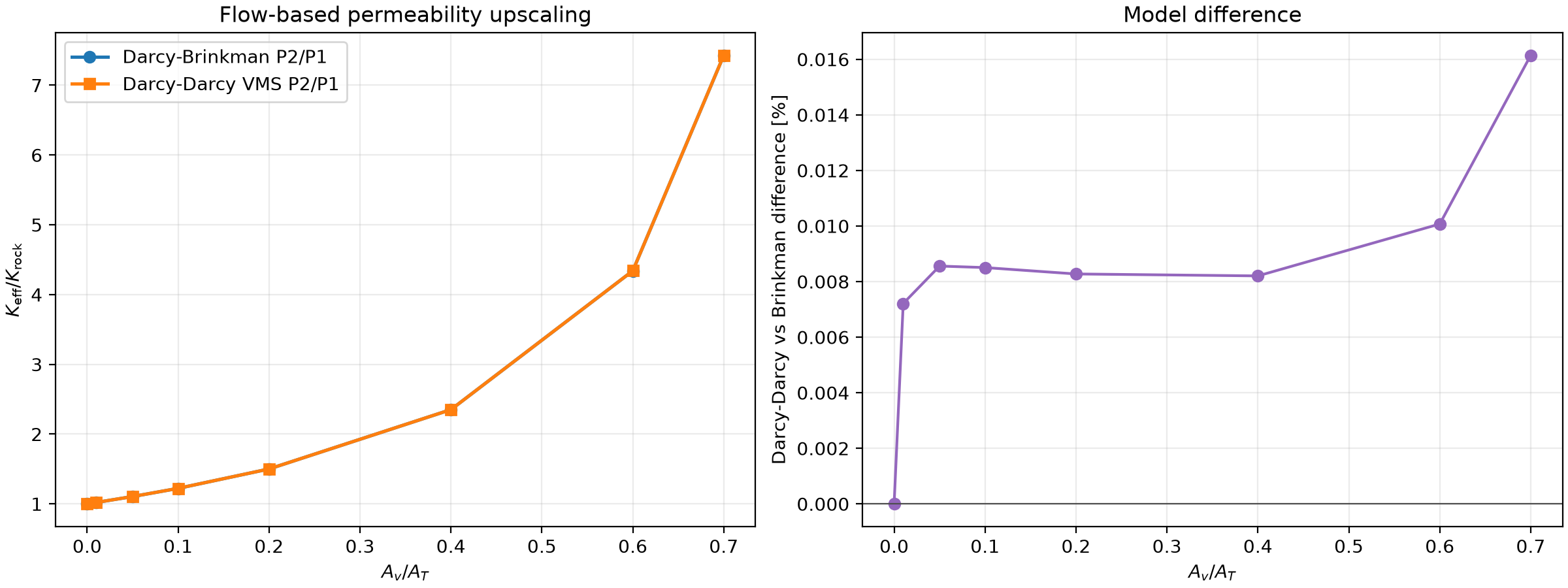
Agreement between these two parameter choices is a formulation comparison, not proof that \(K_v=10^{-8}\,\mathrm m^2\) is unique or physical. The full results and represented fractions are available as CSV.
Executable MWE and notebook
The compact script
examples/fem_mms/vug_2d.py
solves four representative fractions and writes field galleries:
Use --full-family --resolution 100 --export-xdmf for the eight-case
report configuration and ParaView output.
The research notebook
53_mwe_body_fitted_2d_centered_vug_upscaling.ipynb
runs all eight fractions at resolution 100, plots every pressure and velocity
field and the three centerline quantities, performs a 70% mesh-sensitivity
check, and exports XDMF/HDF5 files for ParaView.
The matrix screening length \(\sqrt{K_m/\phi_m}\approx1\,\mu\mathrm m\) is much smaller than the nominal \(106\,\mu\mathrm m\) triangle diameter. Therefore the integral permeability comparison is meaningful here, while the pointwise interface layer is not claimed mesh-resolved.