Three-Dimensional Brinkman MMS Report
The 3D manufactured case exercises tetrahedral assembly, vector derivatives, pressure stabilization, and the triangular-facet coefficient independently of the 2D implementation.
Exact divergence-free solution
On \(\Omega=(0,1)^3\), let
The mixed derivatives cancel in \(\nabla\cdot\mathbf u_{\rm ex}\), and the
bubble makes velocity zero on all six faces. With \(\nu=10^{-2}\) and
\(\gamma=1\), voids manufactures the same strong residual as in the
2D report. The exact velocity is imposed on the complete
boundary, and pressure error is compared modulo its mean.
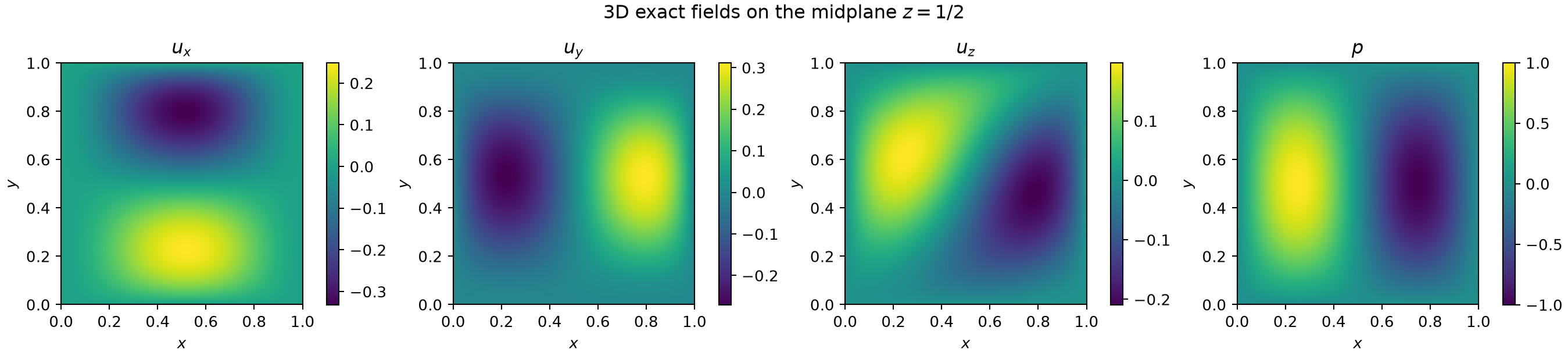
The image is a \(z=1/2\) section through the analytic 3D functions; it is an illustration, not a sampled finite-element result.
Five-level convergence study
The meshes use \(n=(4,6,8,10,12)\) subdivisions per direction and contain
\((384,1296,3072,6000,10368)\) tetrahedra. Taylor--Hood, P1/DG0 USFEM, and
P1/DG1 USFEM are compared on the identical mesh sequence. The USFEM report
profile uses facet_size_mode="representative", hence
\(h_F=\sqrt{2}/n\), and a 24-level reference-face solve for face3d.
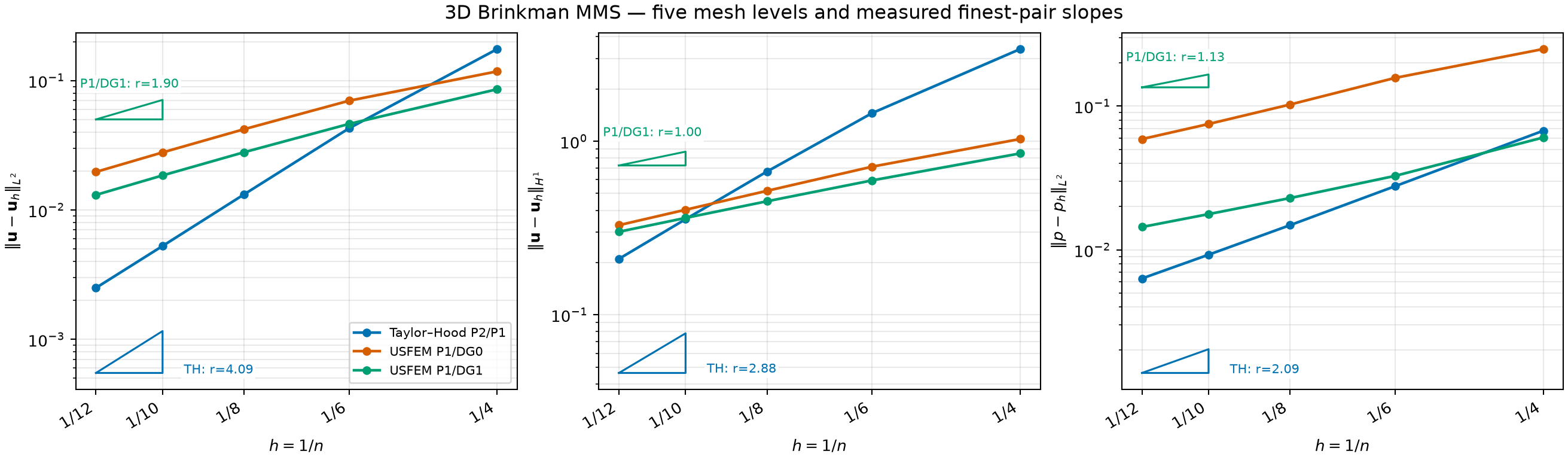
| Method | \(r(L^2_u)\) | \(r(H^1_u)\) | \(r(L^2_p)\) | Finest \(L^2_u\) | Finest \(L^2_p\) |
|---|---|---|---|---|---|
| Taylor--Hood P2/P1 | 4.088 | 2.884 | 2.088 | \(2.498\,10^{-3}\) | \(6.313\,10^{-3}\) |
| USFEM P1/DG0 | 1.901 | 1.121 | 1.326 | \(1.968\,10^{-2}\) | \(5.894\,10^{-2}\) |
| USFEM P1/DG1 | 1.901 | 1.004 | 1.131 | \(1.307\,10^{-2}\) | \(1.441\,10^{-2}\) |
Each curve contains five live solves and each triangle reports a measured finest-pair slope. The two linear-velocity formulations recover approximately second-order \(L^2\) and first-order \(H^1\) behavior. Taylor--Hood is superconvergent in velocity for this symmetric polynomial case; the nominal portable expectation remains \(3/2/2\), not \(4/3/2\). The raw table is available as CSV.
The 3D face3d law comes from a numerical reference-triangle subproblem. Its
observed convergence is evidence for the implemented structured-tetrahedron
study, not a general stability proof for arbitrary anisotropic tetrahedra.
The presentation-replication profiles additionally provide the longer
\((4,6,8,10,12,16,20)\) sequence for report-value regression.
Executable MWE
examples/fem_mms/mms_3d.py
recreates the five-level table, analytic section, convergence plot, and rate
assertions:
The terminal \(12^3\) Taylor--Hood and P1/DG1 direct solves are intentionally nontrivial. For fast smoke testing, shorten the sequence; do not present the resulting coarse slopes as the documented convergence study.